5 Essential Things in Garment Quality Control Inspections
Garment Quality Control in Every Stage
Inspections are common like most product categories. But it is extremely important for manufacturing garments that are more prone to human errors & mistakes. In the textile industry, quality control is normally practiced in every stage from sourcing raw materials to delivering finished garments. To achieve satisfactory garments in colors, design, styles, the fitness of the product for the market, and suitability of components, quality inspection should be done rigorously. Admittedly, it has no alternative.
However, investment in buying garments from suppliers especially ASIAN & Chinese inevitably entails a huge risk during this pandemic situation. If you are obsessed with the quality of your supplier, it is high time you should contact a third-party inspection agency that will inspect the garment’s quality and generate a reliable report which you can trust.
5 Essential things in Garment Quality Control
Ensuring your garment quality adhere to your requirements, you can check the following 5 essential aspects of garments.
a. Dimensions of Garments:

It should be an intrinsic part of your checklist while you are checking the garment’s quality. If garments are not well sized, customers will not be satisfied wearing them. Poor-fitting garments will not only increase the volume of return products in your warehouse but also decay the selling. As a result, the money invested in buying these items will be clogged and interrupt the business function.
Therefore, the first and foremost objective is to ensure the proper dimension of garments. On the contrary, you cannot ensure 100% accuracy in dimensioning while manufacturing garments. To trade off this, you have to determine a tolerance limit and accept the items within the range before mass production. and then the factory should follow up with the size chart precisely, For example, if the length of two legs of a pant differs by even one inch, garments will become unwearable.
b. The Function of Pullers, Buttons, Zippers, and other Accessories
Garments are not a few plain pieces of fabric stitched together. There are other things like snaps, zippers, buttons, ribbons, and elastic bands that are also a part of finished garments. The quality of these accessories should be checked as well during the inspection.
-
# Pull test
Check whether these accessories are securely attached or not by pulling at the accessory by a pull gauge for approximate 10~12 seconds
-
# Fatigue test
Check whether all accessories are functional and the garment is undamaged after fatigue testing.
-
# Stretch test
Check elasticity and breakage in elastic fibers or stitching.
c. Quality of Fabric
The vital aspect of any garment. Customers usually focus on the quality of fabric once the design is acceptable. The price of the garments is highly dependent on the fabric’s quality. Therefore, it is always a major determinant of the quality and salability of any finished product.
# GSM
You can check fabric density by measuring Grams per square meter, which is commonly known as GSM in the textile industry. Measuring GSM requires little training and equipment.
# SPI
SPI is identified by counting the number of stitches in a selected area of the garment using tape and under adequate lighting. Stitch density is certainly an important determinant of the garment’s quality as well as durability.
Apart from GSM and SPI, you can assess the quality of fabric by checking the following characteristics of fabrics.
- Fabric Construction
- Softness
- Shrinkage
- Shade Matching
- Diameter
- Dyeing Levelness
- Ecological parameters
- Fabric Holes
- Dirts & Stains
- Vertical & Horizontal Stripes
- Knitting defects
- Bowing
- Matching of Rib, Collars & Cuffs
- Skewing
- Yarn defects like thick & thin places
d. Packaging and Labeling of Garments
Proper packaging and labeling are another essential part of garments. Proper packing is required to be ensured that goods will arrive at their destination in good condition. Apart from packaging, labeling is also an important feature. Labels usually contain the country of origin, fabric type, size, washing instruction, manufacturer identity, etc.
e. Quality Defects and Severity

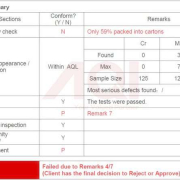
A report on visual inspection is another step in a series of activities of quality checking. (Learn more about What’s AQL in Garment Inspection and AQL Table)
Shading variance, an untrimmed thread, and a loose needle left are some common defects you can visualize with your eyes from the random inspection.
Apart from the above issues, the inspector should also randomly select a few garments and check the following during the Garment Quality control inspections
- Garment length
- Shoulder length
- Arm-hole
- Neck width
- Body width
- Placket length
- Sleeve length
- Placket width
- Arm Opening
- Neck opening
- Hemming width
Tips For How To Measure Garments?
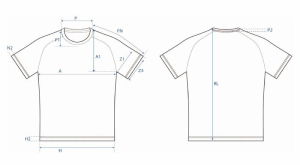 Here are some tips on how to measure garments accurately:
- Keep the garment on a flat surface so that you can measure it perfectly and accurately.
- Do not stretch the garment in any way during measuring because it will alter the real measurement.
- Measure the garments at the initial phase before trailing with a model or dummy
- In the last phase, stretch the garments on any side and take a measurement.
- During measurement of garments with measuring tape, always touch it on the surface
Unless you get quality products from your supplier, you cannot meet your customer’s expectations. Once your customer turns face to another brand, it will be very tough to get them returned. To sustain in this competitive market, you cannot overlook quality issues anyway. You cannot convince your buyer by showing an excuse. Therefore, if you find a new supplier, you must check the quality of the garments. If you are unable to visit their factory due to COVID-19, you can hire a third party who is an expert in garment quality inspection. you should not skip this fundamental step. (Learn more about What is a Third-Party Inspection Agency)
Related:
- 5 Type of Different Garment Inspection Sampling Methods in Quality Control
- Top 5 Ways in Garments Inspection to Ensure Quality Standards
- Textiles and Garments Quality Inspection Service
Author: AQI Service as a professional quality control service company in China specialized in providing a complete range of quality inspection and testing certification services in China & Asia for global importers, buyers, retailers, and sellers.