Air Fryer Buying Guide: A Comprehensive Guide to Choosing, Understanding, and Ensuring Quality
Introduction: The Air Fryer Revolution in Modern Kitchens
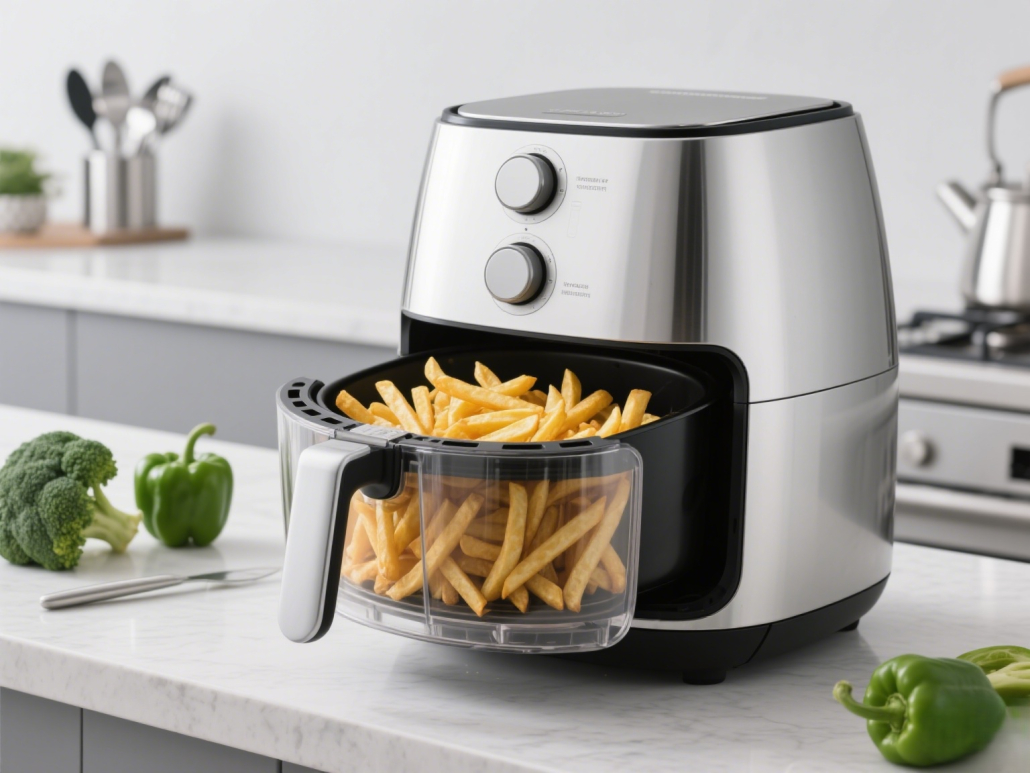
In recent years, air fryers have emerged as a staple in households worldwide, celebrated for their ability to deliver crispy, delicious meals with less oil than traditional frying methods. As consumer demand for healthy cooking solutions grows, China’s air fryer market has expanded rapidly, with a wide range of products catering to diverse needs. However, this growth has also highlighted the importance of rigorous quality control to ensure safety, performance, and reliability.
This guide combines expert insights on choosing the right air fryer with an in-depth look at the quality control standards that protect both consumers and manufacturers.
How Air Fryers Work: Redefining Healthy Cooking
A) The Science Behind Oil-Free (or Low-Oil) Cooking 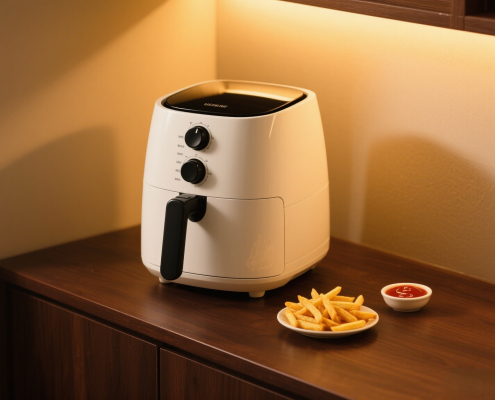
Air fryers transform home cooking through a simple yet effective mechanism: a built-in high-speed fan circulates hot air around ingredients, creating a crispy outer layer using either the food’s natural oils or minimal added oil. This process locks in moisture, resulting in the coveted “crispy outside, tender inside” texture without the excess fat of traditional frying.
Tests show that air-fried fries, for example, contain approximately 70% less fat than their deep-fried counterparts, making air fryers a top choice for health-conscious families. Beyond reducing fat, they preserve the original flavor and nutrients of ingredients, from vegetables to meats, making them versatile for daily meals and snacks.
B) Types of Air Fryers: Matching Design to Your Needs
Not all air fryers are created equal. Their structural designs, capacities, and functionalities vary significantly, so choosing the right type depends on your household size, cooking habits, and kitchen space.
C) Stirring-Type Air Fryers: Convenience for Busy Lifestyles
Ideal for busy professionals or cooking beginners, stirring-type air fryers feature a built-in rotating paddle in the heating chamber. This paddle ensures ingredients (like fries or nuts) cook evenly without manual flipping, saving time and effort. However, the paddle may damage fragile foods (such as fish fillets), so consider your typical recipes before purchasing.
D) Cylindrical Basket Air Fryers: Compact Basics for Small Households
The most common entry-level option, cylindrical basket air fryers use a drawer-style detachable basket (usually under 3 quarts/2.8 liters). A top fan drives hot air through holes in the basket, heating ingredients quickly—preheating is often 30% faster than larger models. Perfect for 1-2 person households, they excel at single-serving meals or snacks but lack the capacity for large families.
E) Countertop Convection Oven-Style Air Fryers: Versatility for Families
These multi-functional appliances blend air frying with oven capabilities, featuring multiple racks or trays and capacities up to 26 quarts (23.7 liters). Beyond air frying, they support baking, rotisserie, grilling, and roasting, making them a “one-machine solution” for 3-4 person families. Their large capacity handles main dishes (like whole chickens) and desserts alike, appealing to users seeking versatility.
F) Halogen Air Fryers: Visual Control for Precision Cooking
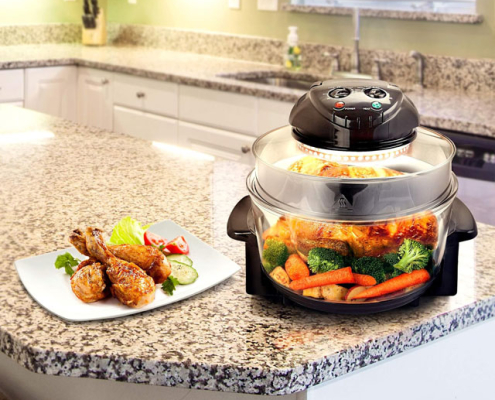
The Multipurpose Halogen Oven Air fryer from Megachef
Halogen air fryers use a halogen lamp for heating, paired with a fan to circulate air. Their transparent glass bowl design lets users monitor cooking in real-time, ideal for recipes requiring precise heat control (such as baked goods or delicate meats). Glass conducts heat efficiently, but users must exercise caution—high temperatures demand proper insulation to prevent burns.
G) Oil-Free Turkey Fryers: Specialized for Large-Scale Cooking
Designed for oversized ingredients like whole turkeys or large meat batches, these barrel-shaped appliances use air circulation to cook evenly, avoiding the “burnt outside, raw inside” issue of traditional methods. While popular for Western holiday gatherings, their large size makes them less practical for daily use in most Chinese households.
Ultimate Air Fryer Buying Guide: Key Factors to Consider
Selecting the right air fryer requires balancing practicality, performance, and budget. Here’s what to evaluate before making a purchase:
A) Capacity & Size: Fit for Your Household
Capacity directly impacts cooking efficiency. Match it to your family size:
- 1.5–2 quarts (1.4–1.9 liters): Best for 1–2 people (single-serve fries, chicken wings).
- 3–4 quarts (2.8–3.8 liters): Suitable for 3–4 people (daily meals like grilled fish or whole chickens).
- 5–6 quarts (4.7–5.7 liters): Ideal for large families or hosting (batch cooking multiple ingredients).
Measure your kitchen counter space too! Cylindrical models typically occupy ~30cm×30cm, while convection oven-style units may need 50cm×40cm or more.
B) Power: Heating Speed & Temperature Limits
Power (1200–2000 watts) determines how quickly an air fryer heats and its maximum temperature:
- 1200–1500 watts: Works for low-temperature cooking (vegetables, baked pastries) up to 350°F (177℃).
- 1600–2000 watts: Supports high-heat cooking (350°F–400°F/177℃–204℃) for crispy meats or fries.
For “crispy outside, tender inside” results, opt for 1800+ watts to avoid uneven heating or long cook times.
C) Ease of Use & Cleaning: Practicality Matters
A user-friendly design boosts daily usability:
- Control Panels: Touchscreens suit tech-savvy users, while knobs are simpler for beginners or the elderly.
- Detachable Parts: Prioritize dishwasher-safe baskets/trays to reduce cleanup time.
- Non-Stick Coatings: High-quality Teflon or ceramic coatings prevent sticking—just avoid metal utensils that scratch them.
D) Temperature Control & Functionality
Look for a wide temperature range (180°F–400°F/82℃–204℃) to handle diverse recipes:
- Low (180°F–250°F): Thawing or drying ingredients.
- Medium (250°F–350°F): Baking pastries or cooking vegetables.
- High (350°F–400°F): Frying or roasting for crispy textures.
Bonus features like preset menus (fries, wings), timers, and preheating reminders add convenience.
E) Energy Efficiency & Safety Certifications
- Energy Efficiency: Choose Class 1 energy-efficient models to lower long-term electricity costs, especially for high-power units.
- Safety Features: Ensure overheat protection (auto-shutoff), anti-scald handles, and certifications like China’s 3C, EU’s CE, or US’s UL. These guarantee compliance with global safety standards.
F) Price & Brand: Balancing Quality & Budget
Air fryers range from budget-friendly to premium:
- Under ¥500: Basic cylindrical models for simple needs.
- ¥500–¥1500: Mid-range options (e.g., Midea, Joyoung) with reliable materials and full features.
- Over ¥1500: High-end or imported models (e.g., Philips, Tefal) with smart controls and large capacities.
Most air fryers are made in China, so domestic brands often offer better value and local recipe adaptation than imports.
Air Fryer Quality Control: Why Inspection Matters
With market growth comes varying product quality—from minor defects to safety hazards like electric leakage or overheating. Rigorous quality control, enforced by third-party inspectors, is critical to protecting consumers and brands.
The Impact of Quality Testing: A Win-Win for All
For Manufacturers:
Reduces costs from returns, recalls, and reputational damage. A single large recall can cost millions, but pre-production testing cuts such risks by 80%+.
For Consumers:
Ensures products meet safety and performance claims, preventing accidents (burns, shocks) and guaranteeing consistent cooking results.
For the Industry:
Drives standardization, eliminates low-quality products, and promotes innovation in safety and efficiency.
Full-Process Quality Control for Air Fryers
At third-party inspection company, we oversee quality across the entire production lifecycle, from raw materials to final shipment.
Step 1: Supplier Audits – Securing Quality at the Source
Before production, we verify raw material suppliers (metal shells, heating tubes, motors) by checking:
- Production licenses and ISO 9001 certification.
- Material certificates (e.g., stainless steel composition, plastic heat resistance).
- Past supply records to ensure consistency.
Step 2: In-Process Inspections – Catching Issues Early
During mass production, our inspectors monitor:
- Assembly quality (screw tightness, wire connections) to prevent short circuits.
- Component consistency (heating tube power, fan speed vs. design specs).
- Surface defects (scratches, color mismatches) to stop flawed products from advancing.
Step 3: Pre-Shipment Inspection – Final Verification
This critical step ensures products are ready for market:
Packaging & Labeling:
Check for sturdy boxes, clear branding, 3C certification, and accurate manuals.
Accessory Completeness:
Verify all parts (cords, baskets, cleaning tools) and manual accuracy (safety warnings, steps).
Appearance & Function:
Inspect for burr-free shells, uniform coatings, and smooth operation. Test heating speed, temperature stability, noise, and timers.
Safety Tests:
Conduct withstand voltage tests and grounding resistance tests to check for leaks. Ensure surface temperatures stay under 60℃ during use.
Core Testing Standards & Criteria for Air Fryers
AQI SERVICE uses industry standards and customized checklists to evaluate key metrics:
A) Appearance & Structure Testing
Defects are classified to prioritize fixes:
- Critical Defects: Safety risks (cracked shells, exposed wires, damaged cords).
- Major Defects: Function/longevity issues (coating peeling, stuck buttons, unclosable baskets).
- Minor Defects: Cosmetic flaws (scratches <2mm, slightly skewed labels).
(Related: 3 Defects Classification in AQL Product Inspection)
Testing: Visual checks under standard light (50cm distance) and caliper measurements (dimensional errors ≤1mm).
B) Function & Performance Testing
- Heating Efficiency: Time to reach 375°F (±5 minutes) and temperature uniformity (±10°F across the chamber).
- Temperature Accuracy: actual temps must stay within ±15°F of set values (200°F, 300°F, 400°F).
- Fan & Motor Performance: Noise ≤65 decibels (1m distance); motor temperature rise ≤40℃ after 2 hours of use.
- Timer Accuracy: Actual run time vs. set time (±1 minute for 10/30-minute settings).
C) Reliability & Durability Testing
Laboratory tests simulate long-term use:
- Life Cycles: 500 “heat-cool” cycles (30 minutes on, 15 off) to check for core component aging.
- Environmental Resistance: 4-hour high-temperature (40℃) runs, 1-meter drop tests (packaged), and 24-hour 90% humidity exposure (insulation resistance ≥2MΩ).
D) Safety Compliance Testing
Products must meet global standards:
- China: GB 4706.1-2005 and GB 4706.14-2008 .
- EU: EN 60335-1 and EN 60335-2-9.
- US: UL 60335-1.
Key tests include:
- Electrical strength (1500V AC for 1 minute, no breakdown).
- Ground continuity (resistance ≤0.1Ω).
- Anti-shock protection (no access to live parts via test fingers).
- Overheat protection (auto-shutoff at 250℃).
AQL Standards: Ensuring Consistent Quality
To maintain objectivity, AQI SERVICE uses Acceptance Quality Limits (AQL) for defect judgment:
- AQL 1.5 for major defects; AQL 4.0 for minor defects.
- Sampling: 80 units for batches of 800.
- Pass Criteria: ≤3 major defects or ≤7 minor defects per sample.
Examples:
- Major: Non-heating elements, ±20°F+ temperature deviation, loose handles.
- Minor: Manual typos, slight color differences, minor packaging dents.
Laboratory Specialized Testing: Deep Reliability Checks
Advanced tests validate long-term performance:
- Material Analysis: Spectrometers check stainless steel corrosion resistance; thermogravimetric analyzers verify plastic heat resistance (≥120℃).
- Coating Tests: 1,000 cotton cloth rubs (no peeling) and 24-hour vinegar immersion (no rust).
- Motor Life: 1,000 hours of rated use with ≤10% speed decay.
- EMC Testing: Ensures no electromagnetic interference with other appliances and stable operation during power fluctuations.
Conclusion
Air fryers offer a healthier, more convenient cooking experience, but their benefits depend on reliable quality. For consumers, prioritize 3C-certified products with clear inspection reports. For manufacturers, partnering with third-party inspectors like AQI SERVICE ensures compliance, reduces risks, and builds trust.
At AQI SERVICE, our expertise in air fryer testing—from supplier audits to laboratory verification—helps deliver safe, high-performance products to market. Contact us today to learn how we can support your quality control needs.