CPSC Compliance in 2026: Record Recalls, Real Risks, and What Importers Should Be Doing Differently
If your supply chain runs through Asia and your products land in the U.S. market, you’ve probably noticed that CPSC enforcement has felt increasingly aggressive over the past year or two. You’re not imagining it. The data from 2025 and early 2026 confirms what many importers are experiencing firsthand: the Commission has moved from a largely reactive posture to something closer to continuous, predictive market surveillance – and the results are showing up in recall volumes that have no modern precedent.
This piece is for procurement managers, product managers, and import operations teams who carry actual responsibility for getting goods through customs and keeping them on the shelf. We’re going to work through the enforcement numbers, the product categories drawing the most attention, the root causes that keep coming up in recall investigations, and what a practical, genuinely protective CPSC compliance framework looks like in 2026.
The U.S. Recall Landscape in 2025–2026: Understanding the Scale of Enforcement
Recall Volumes That Have Broken Historic Records
The CPSC issued 142 recall notices in Q1 2026 alone – a 40.6% year-on-year spike compared to Q1 2025. That works out to roughly three or four enforcement actions every 48 hours. For the full calendar year 2025, the Commission executed more than 400 recalls covering over 20 million individual product units, representing an annualized increase of more than 25%. (Get more data in Recalls & Product Safety Warnings)
These aren’t numbers driven by a single incident or a single bad actor. They reflect a structural change in how the CPSC operates: automated port-of-entry screening, e-commerce data scraping, and a synchronized consumer complaint pipeline that feeds enforcement actions much faster than it used to. Products with CPSC compliance gaps are being identified earlier in the distribution cycle, and the Commission is acting before goods reach consumer hands rather than after.
For importers, that changes the risk calculation significantly. The window between a non-compliant product entering the supply chain and a recall action has gotten narrower, and the financial consequences – product seizure, mandatory recall logistics, legal exposure, retailer chargebacks – have gotten larger.
Why Imported Products Face the Highest Exposure
Cross-border supply chains are bearing the overwhelming share of this enforcement pressure. Imported consumer goods accounted for more than 90% of all recall actions in early 2026. Within that group, products manufactured in Asian supply chains – particularly China – have drawn the most concentrated scrutiny.
In early 2026, 120 documented recall cases involved Chinese-manufactured products, representing a 73.9% year-on-year increase for that trade corridor and accounting for an estimated capital exposure of $2.08 billion. That figure reflects goods already in the distribution system – retailer inventory, importer warehouses, products in transit – that had to be removed from commerce.
The core issue here isn’t simply manufacturing quality, though that’s part of it. The more persistent problem is the gap between what factories understand about their own CPSC compliance obligations and what the actual U.S. regulatory framework requires. Many mid-market importers fill that gap with supplier assurances or factory-issued documentation – a model that holds up fine until it doesn’t, and when it fails, the importer carries the liability.
Critical Safety Hazards: The Human and Financial Cost of Failures
The CPSC’s mandate centers on preventing unreasonable risks of injury or death. Over 95% of recent recalls stem from severe bodily harm hazards, with more than 60% involving immediate, life-threatening scenarios that directly violate foundational CPSC product compliance rules.
- Choking and Aspiration Hazards (22%): Detachable small parts, migrating internal components, or structural breakages in products intended for children.
- Mechanical Instability and Tip-Over Risks (18%): Structural failures in case goods, seating, and elevated frameworks.
- Thermal and Fire Anomalies (15%): Lithium-ion battery failures, inadequate insulation, and catastrophic circuit overloads.
- Chemical Incompatibility and Toxicity (12%): Banned phthalates, restricted heavy metal concentrations, and hazardous substrate contamination.
- Dielectric Breakdown and Electric Shock (10%): Inadequate creepage distances, poor grounding, and manufacturing defects in consumer electronics.
- Anatomical Entrapment and Pinch Risks (8%): Substandard spacing in juvenile furniture and mechanical mechanisms.
High-Risk Product Categories and What’s Actually Going Wrong
Juvenile Products – The Strictest Scrutiny in Any Category
Juvenile products accounted for 42.5% of all CPSC enforcement actions in Q1 2026, with 51 major cases recorded in a single quarter. That makes this the single highest-risk category for importers by a wide margin. Cribs, bassinets, baby carriers, high chairs, and infant sleep products are all governed by mandatory federal standards that leave very little interpretive room – either a product meets the specification or it doesn’t.
The most common failure mode in infant sleep environments involves dimensional non-compliance: mattress deflection exceeding allowable tolerances, product incline angles above the 10-degree maximum, or perimeter materials that don’t provide sufficient structural containment. A January 2026 recall of BBWOO Baby Loungers, sold through Amazon by LSY-Direct, illustrates the pattern clearly. The product’s sides were too low to contain an infant, and the foot-end openings were wider than permitted under the mandatory infant sleep product standard – creating both fall and entrapment hazards. These weren’t manufacturing defects. The product was designed outside the compliance parameters from the outset. (More about 16 CFR Part 1218 and 16 CFR Part 1219)
Chemical compliance is the second major failure vector in this category. Lead-based surface coatings above 90ppm (16 CFR Part 1303) and phthalate concentrations exceeding 0.1% in accessible materials (16 CFR Part 1307) are absolute prohibitions. Verification has to happen on production-run samples through an accredited third-party laboratory – not prototype samples, and not on the basis of factory-issued declarations.
For any product classified as a children’s product under the CPSIA, third-party testing is a legal requirement, not a best-practice recommendation. A valid Children’s Product Certificate (CPC) from a CPSC-accepted lab is the baseline documentation that any importer in this space needs to maintain.
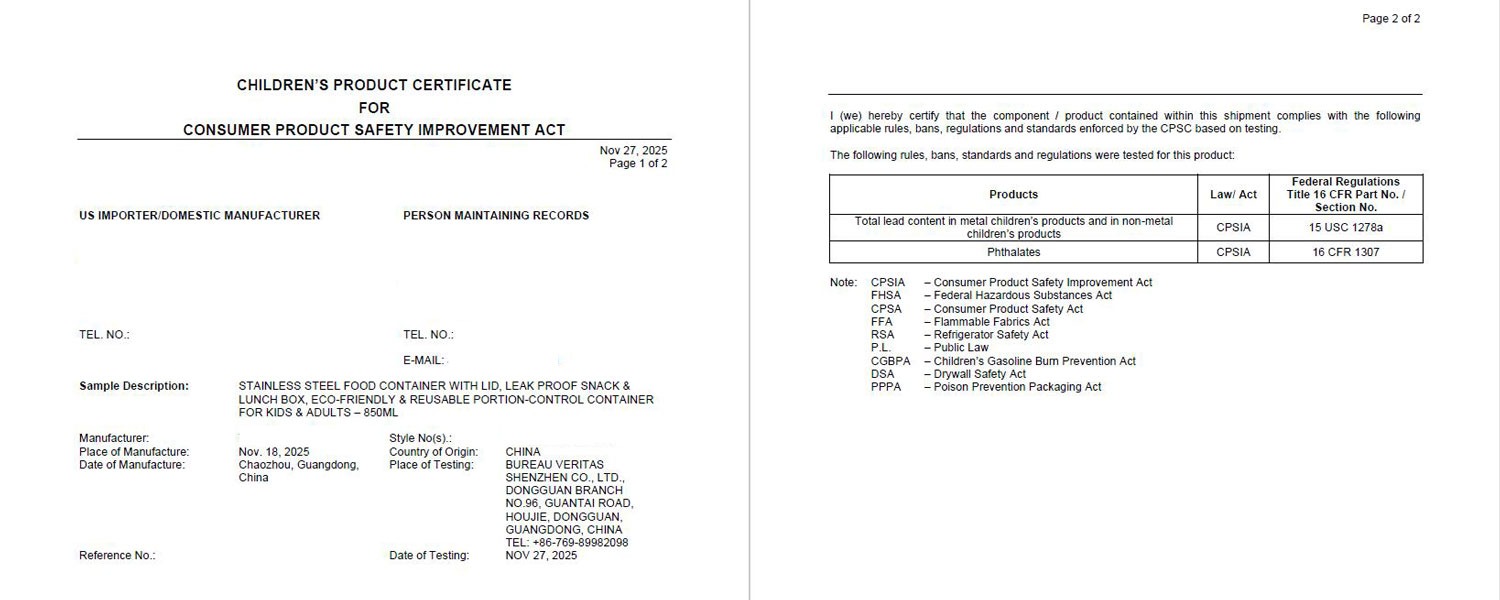
(CPC_Certification_Sample)
Toys – Layered Risk Across Mechanical, Chemical, and Electrical Compliance
Toys represented 21.1% of early 2026 recalls, making them the second highest category by enforcement volume. The compliance challenge with modern toys is that they often combine mechanical, chemical, and electrical elements simultaneously, each carrying its own testing framework under ASTM F963 and CPSIA Section 101.
For products intended for children under three, small-part testing under standard torque and tension protocols is mandatory. Components that detach during that testing – eyes, gears, battery covers, decorative attachments – are automatically classified as choking hazards regardless of how they were intended to function. High-powered rare-earth magnet sets present a separate and more severe risk: when multiple magnets are swallowed separately, they attract across intestinal walls, creating surgical emergencies that have resulted in fatalities.
The chemical dimension was brought into sharp focus by a significant May 2026 enforcement action: 121,340 units of liquid-filled tactile squeeze toys were recalled after laboratory chemical extraction discovered tremolite asbestos in the interior fill compound. Asbestos inhalation is a severe carcinogenic risk, and the contamination entered through unverified raw materials used in the fill compound – the kind of substitution that would never appear on a factory-supplied component declaration but shows up immediately in independent chemical analysis.
Batch-by-batch laboratory verification is the only reliable safeguard here. Factory component data sheets do not constitute compliance evidence for the U.S. market.
Furniture – The STURDY Act Has Fundamentally Changed the Testing Bar
Furniture accounted for 10.8% of early 2026 recalls, and the fully enacted STURDY Act (Stop Tip-overs of Unstable, Risky Dressers on Youth), codified under 16 CFR Part 1261, has raised the compliance standard for clothing storage units in ways that many overseas manufacturers haven’t fully absorbed.
The pattern in recent furniture recalls is instructive. More than 500,000 dressers across multiple import brands were pulled from the market because manufacturers had not tested under realistic conditions. The STURDY Act’s stability requirements call for testing with extended drawers under weighted load, placed on carpeted surfaces, simulating a child climbing on an open lower drawer. That last scenario – a child using the open drawer as a step – is exactly what most factories were not testing for, because it wasn’t part of earlier industry practice.
If your furniture product specs don’t explicitly require STURDY-compliant testing conditions, your factory almost certainly isn’t running them. Low-density particleboard, substandard drawer slides, and tip-over restraint hardware that uses brittle plastic components are all recurring failure points that proper pre-shipment testing catches before goods leave the factory.
Electronics and Small Appliances – Electrical Safety Gaps That Can’t Be Fixed in the Field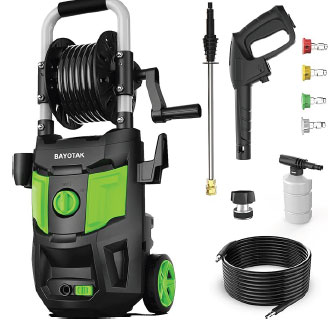
Electronics and small appliances recorded 9 significant enforcement actions in Q1 2026 alone, covering pressure washers, lithium-ion charging systems, and portable power equipment. The failure modes in this category range from immediate shock hazard to thermal runaway, and many of them are structural defects that can’t be corrected without a product redesign.
Lithium-ion battery failures remain a persistent problem. When battery management systems fail to prevent overcharging, thermal runaway is the predictable outcome – not an occasional risk but a near-certain one under the right conditions. Inadequate insulation pathing and moisture ingress create shock risks that may not manifest under controlled factory test conditions but emerge in actual consumer use.
A mid-April 2026 enforcement action involving more than 300 commercial-grade pressure washers makes the stakes concrete. Inspection confirmed that the products lacked a mandatory integrated Ground Fault Circuit Interrupter (GFCI) in the primary power cord – a basic requirement for electrical products used near water under North American safety standards. The omission was a design specification gap, not a manufacturing defect, which meant there was no corrective action available short of a full product redesign. The entire lot had to exit the market.
All consumer electronics and small appliances for the U.S. market should be validated against UL 60335-1 or the applicable product-specific UL standard before production sign-off. Hi-pot testing, grounding continuity checks, and thermal evaluation under fault conditions should be standard elements of the pre-shipment inspection protocol.
The Root Causes Behind Failures in CPSC Compliance
Understanding the enforcement data is useful. Understanding where failures originate in the supply chain is more useful, because that’s where intervention actually prevents recalls rather than just documenting them.
Design and Engineering – The Earliest and Most Expensive Failure Point
More than 40% of documented recalls trace back to the product design stage, not the manufacturing stage. Overseas factories often develop products with unit cost and visual appeal as the primary design drivers, with no meaningful integration of U.S. regulatory requirements into the engineering process. The result is products with structural tolerances, accessible opening dimensions, or load specifications that were never viable for the U.S. market from the moment the drawings were finalized.
CPSC compliance review needs to be embedded in the product development process – at the CAD drawing stage, before tooling is committed. Engineering teams should be checking mechanical drawings against current federal standards: accessible opening geometries to prevent entrapment, center-of-gravity calculations for furniture, thermal protection specifications for electronics. Catching these issues before tooling is approved costs a fraction of what a production-run recall costs.
Roughly 25% of recall incidents involve material substitution – a situation where pre-production samples test clean but full-scale production uses cheaper, unverified raw materials. Unregulated colorants, low-grade plasticizers, contaminated chemical fill materials: these substitutions happen most often under margin pressure during long production runs, and they’re essentially invisible unless you’re running independent chemical verification on production-run samples rather than just pre-production prototypes.
The practical response is threefold: independent chemical screening on raw materials before production begins, batch-level material traceability documentation with lot numbers, and supplier contracts that include financial penalties for undisclosed substitutions. Factories that know the importer is running independent verification at the raw material stage are significantly less likely to make unauthorized substitutions.
Invalid or Outdated Testing Documentation
Around 20% of affected importers are operating on compliance documentation that wouldn’t survive regulatory scrutiny: factory-issued internal test reports, certificates from non-accredited facilities, or lab reports covering an earlier product version rather than the current production configuration. CPSC port-of-entry inspectors are familiar with these documentation patterns and look for them specifically.
For any children’s product subject to mandatory third-party testing under the CPSIA, a valid CPC must be issued by a CPSC-accepted laboratory, reference the specific production batch being imported, and name the domestic importer of record. A certificate that doesn’t meet those specifications provides no legal protection when an enforcement action is initiated.
Labeling and Tracking Label Failures
Approximately 15% of all CPSC enforcement records are attributable to non-compliant labeling – products that may be safe by design and manufacture but fail to meet mandatory tracking label and warning statement requirements. CPSC compliance requires permanent, legible tracking data allowing any unit to be traced back through the supply chain: manufacturing location, production date, and lot code at minimum. Required warning text must meet format and visibility specifications. Labels that peel off in transit, use unapproved abbreviations, or omit required content turn a technically safe product into a non-compliant one, and that’s sufficient grounds for a mandatory recall.
Building a CPSC Compliance Framework That Works End-to-End
The importers who navigate this environment successfully aren’t relying on luck or on trusting their factory partners to self-certify. They’ve built a structured, end-to-end quality assurance process that addresses compliance at every stage of the supply chain – from product development through final shipment.
Compliance Review at the R&D and Engineering Stage
Before a single unit is produced, the product design should be reviewed against the applicable CPSC and ASTM standards. This means checking accessible opening dimensions for entrapment risk, verifying center-of-gravity calculations for furniture, and ensuring that electronic components include the thermal cutoffs, BMS circuits, and grounding hardware required by North American electrical standards. The engineering stage is where compliance is cheapest to build in and most expensive to retrofit.
Raw Material Supplier Auditing and Incoming Material Verification
An importer’s finished product is only as safe as the materials used to produce it. Factory-level raw material auditing – independent chemical screening of incoming materials, clear batch traceability logs, and contractual accountability for unauthorized substitutions – is the mechanism that prevents chemical compliance failures before they enter the production stream. This is particularly critical for products with filled components, surface coatings, or textile elements, where material substitution risk is highest.
Pre-Production Verification Before Mass Production Begins
Before a full production run is authorized, a formal pre-production inspection confirms that the factory has correctly calibrated its assembly equipment, sourced the exact component brands specified in the design documents, and has personnel who understand the testing standards the product will be evaluated against. This step catches setup errors before they’re multiplied across thousands of units.
Pre-Shipment Inspection – The Final Compliance Gate Before Loading
A professionally executed Pre-Shipment Inspection (PSI), conducted by an independent third-party inspector on completed production-run goods before container loading, is the most operationally practical CPSC compliance safeguard available to importers. Using statistical sampling under ANSI/ASQ Z1.4, inspectors pull random units from the completed lot and run physical and functional safety tests against the applicable standard.
For juvenile products and toys, this includes small-part release testing (torque and tension protocols), drop and compression testing, and dimensional verification of all accessible openings. For electronics, inspectors run hi-pot (electric withstand) tests, grounding continuity checks, and functional overload evaluations. Across all categories, the inspection includes cross-referencing batch codes, tracking label content, and mandatory warning text against legal requirements.
Critical defects under a proper PSI protocol should be treated as zero-tolerance. A GFCI omission found at pre-shipment inspection costs a production correction. The same omission found at port of entry costs a recall.
Laboratory Validation and Children’s Product Certificate (CPC)
For products classified as children’s products under U.S. law, completing a pre-shipment inspection is necessary but not sufficient. A valid CPC or General Certificate of Conformity (GCC) from a CPSC-accepted testing laboratory is a legal prerequisite for importing these products into the U.S. market. The certificate must identify the domestic importer of record, reference the specific production batch, and name the accredited laboratory that conducted the testing. Managing this as a routine part of the production workflow – with standing laboratory relationships and structured sample submission timelines – is how high-volume importers maintain consistent CPSC compliance without delays.
CPSC Compliance as a Supply Chain Advantage, Not Just a Legal Obligation
There’s a business case for CPSC compliance that goes beyond avoiding recalls, and it’s worth naming directly. As major retail buyers and e-commerce platforms face increasing pressure to demonstrate product safety due diligence across their supplier base, importers who can produce complete, third-party-verified compliance documentation have a real commercial advantage over those who can’t. Clean inspection records, valid lab certificates, and documented factory audit histories are increasingly prerequisites for doing business with tier-one retail accounts – not just regulatory requirements.
Independent third-party verification matters here precisely because of its independence. QC records from an inspection organization with no financial relationship to your factory carry evidentiary weight that factory-issued documentation simply doesn’t. When a compliance question arises – whether from a retailer, a customs inspector, or the CPSC itself – documentation from an independent provider is what protects your position.
The enforcement trajectory from 2025 into 2026 points in one direction. The CPSC’s surveillance infrastructure is more capable than it has ever been, the recall velocity shows no sign of slowing, and the regulatory requirements continue to expand. For importers sourcing from Asia, the question is no longer whether non-compliant products will be identified. It’s whether your compliance framework is built well enough to ensure yours aren’t among them.
*AQI Service provides independent pre-shipment inspection, factory audit, and quality control services for importers sourcing from Asia. Our teams are trained to current CPSC mandatory standards across juvenile products, toys, furniture, electronics, and other high-risk product categories.