Factory Audit Checklists for New Suppliers in China and Vietnam

Short Introduction
A factory audit is a structured pre-production evaluation designed to verify whether a supplier can meet your quality, delivery, compliance, and security requirements before you award the first purchase order.
Central to this evaluation are factory audit checklists—standardized tools that translate vague requirements into actionable, verifiable items for on-site assessment. This step is non-negotiable: new supplier selection carries inherent risks, and unmanaged risks often translate into costly rework, late shipments, and chargebacks—faster than most teams anticipate.
One industry study estimates that poor supplier quality, if left unaddressed, can consume up to 15% of a company’s revenue. This is why businesses that conduct early audits consistently experience fewer product launch delays.
This guide translates factory audit theory into a hands-on resource tailored to China and Vietnam. It covers everything you need to implement effective audits: from defining audit types and building factory audit checklists to running on-site assessments, navigating country-specific differences, budgeting for costs, and scheduling re-audits. Whether you’re sourcing electronics from China or apparel from Vietnam, this document replaces abstract standards with a repeatable blueprint for success.
What Is a Factory Audit & Why Does It Matter for New Suppliers?
At its core, a factory audit is a formal assessment of a supplier’s systems, personnel, and processes. Its goal is not to “pass” or “fail” a vendor, but to predict performance and eliminate risks before you invest in tooling or place your first order.
a. Core Objectives of a Factory Audit
A well-executed audit achieves four critical outcomes:
- Verify legal and operational capacity: Confirm the supplier is legally registered, has the equipment and workforce to meet your volume needs, and operates in compliance with local laws.
- Validate process controls: Ensure the factory’s on-site procedures (e.g., quality checks, production workflows) align with your specifications and are consistently followed.
- Align expectations: Clarify standards for sampling, tolerance ranges, defect response times, and communication—so both parties start the partnership on the same page.
- Create a roadmap for improvement: End with a quantified risk rating and a corrective action plan (CAPA) that the supplier co-owns, turning gaps into actionable steps.
b. Why Audits Are Non-Negotiable for New Suppliers
Skipping audits for new suppliers exposes your business to avoidable risks: missed launch dates, non-compliant products that fail customs inspections, or reputational damage from labor violations. By contrast, audits provide transparency: you gain visibility into the supplier’s operations, while the supplier receives clear guidance on meeting your needs. This foundation of trust and clarity is how strong, long-term supply chains are built.
Note: For turnkey on-site support in China or Vietnam (including supplier evaluations, pre-shipment inspections, and lab testing), consider partners like AQI Service—their data can directly integrate into your audit checklist.
3. What are the Main Types of Factory Audits

Audit types are categorized by their focus on specific risk areas, and most buyers combine multiple types into a single on-site visit (scoring each area separately for clarity). Your choice of audit types should align with your product’s risk profile, customer commitments, and regulatory obligations.
3.1 Key Audit Types & Their Purposes
| Audit Type | Core Focus & Purpose |
| Quality Management System (QMS) | Verify that the factory’s documented quality processes (e.g., ISO 9001) are actually implemented on the floor—not just filed away. |
| Process/Technical Capability | Test whether the supplier’s machines, tools, and production methods can consistently meet your product’s technical requirements (e.g., SPC for critical dimensions). |
| Social Compliance | Confirm legal employment practices, safe working conditions, and the absence of risks like hidden child labor or forced overtime. |
| Environmental | Validate that the factory holds required environmental permits, properly manages waste (e.g., hazardous materials), and controls emissions. |
| Security (CTPAT-Aligned) | Evaluate cargo integrity (e.g., seal logs, CCTV) and access control (e.g., restricted warehouse areas) to comply with global trade security standards. |
| Ethical/Anti-Bribery | Mitigate legal and reputational risk by ensuring the supplier adheres to anti-corruption policies and corporate integrity standards. |
3.2 Practical Guidance for Choosing Audit Types
- Complex electronics: Prioritize QMS and Process/Technical Capability audits (to ensure precision manufacturing).
- Apparel/textiles: Emphasize Social Compliance and Security audits (to address labor risks and cargo theft).
- Food contact items: Focus on QMS (traceability) and Environmental audits (to avoid contamination risks).
Tip: If your team lacks bandwidth to run multi-type audits, partner with specialized providers like QCAdvisor. They deliver blended audits with evidence-rich CAPA plans, tailored to China and Vietnam’s local contexts.
4. Quality, Social, & Environmental Audits: Overlaps & Differences
Quality, Social, and Environmental audits share basic procedures (e.g., document reviews, floor walks, management interviews) but differ sharply in their objectives, evidence sources, and remediation timelines. Understanding these differences ensures you don’t overlook critical risks.
4.1 Key Differences at a Glance
| Dimension | Quality Audit | Social Compliance Audit | Environmental Audit |
| Primary Objective | Ensure process consistency and defect prevention | Ensure legal/ethical employment, worker safety, and elimination of hidden child labor/forced overtime | Ensure compliance with environmental laws and pollution control |
| Typical Evidence Sources | Control plans, SPC charts, calibration logs, work instructions | Timecards, payroll records, social security logs, employee interviews, PPE inspections | Environmental permits, waste manifests, spill response kits, emission test reports |
| Common Nonconformities | Missing work instructions, uncalibrated tools, weak change control | Excessive overtime (beyond legal limits), incomplete payroll records, hidden child labor | Improper waste storage, expired permits, lack of spill containment |
| Scoring Focus | Defect rates, traceability, process adherence | Working hours, wage compliance, safety training, child labor/overtime verification | Permit validity, waste diversion rates, emission levels |
| Re-Audit Cadence | 6–12 months | 6–12 months (or immediately after resolving child labor/overtime gaps) | 12 months (or after investing in environmental upgrades) |
4.2 Critical Note on Scoring
Never use a combined score for these three audit types. A “passing” overall score could mask a failing Social Compliance score (e.g., unreported child labor) or a weak Environmental score (e.g., illegal waste disposal)—risks that could sink your product launch or damage your brand. Always score each type separately to make informed risk decisions.
5. Building Your Factory Audit Checklist
A strong checklist translates risks into observable, verifiable questions. It must be thorough enough to catch systemic gaps but practical enough to complete in one day. Below is a step-by-step guide to designing and structuring your checklist.
5.1 Core Design Principles
- Logical flow: Start with foundational checks (company legal status) and move through the production value stream (incoming materials → production → shipping), ending with people and compliance (social, environmental, security).
- Verifiable evidence: Every question should require evidence that can be confirmed via triangulation—documents (e.g., timecards), interviews (e.g., worker conversations), and floor observations (e.g., machine calibration stickers).
- Risk-based weighting: Assign higher scores to high-impact items (e.g., “critical gauge calibration” = 10 points) and lower scores to low-impact items (e.g., “dusty canteen shelves” = 1 point).
- Clear criteria: Predefine what counts as a “Major Nonconformity” (e.g., hidden child labor), “Minor Nonconformity” (e.g., missing work instruction for a low-risk step), and “Observation” (e.g., disorganized storage). This avoids ambiguity during the audit.
5.2 Must-Include Checklist Sections
Your checklist should cover 15 core sections, with tailored questions for China and Vietnam:
5.2.1 Company Profile & Legal Registration
Verify business license, tax registration, and export permits (ensure validity for China’s SAIC or Vietnam’s Department of Planning and Investment).
Confirm the factory’s registered address matches the audit location (to avoid “shell company” risks).
5.2.2 Quality Management System (QMS)
Review documented QMS (e.g., ISO 9001) and check if revisions are controlled (versioning, approval signatures).
Verify that quality objectives (e.g., <1% defect rate) are tracked and reviewed by management.
5.2.3 Incoming Material Control
Check procedures for inspecting raw materials (e.g., AQL sampling for textiles) and rejecting non-conforming batches.
Review records of supplier evaluations for key materials (e.g., PCB suppliers for electronics).
5.2.4 Process Control & Change Management
For each production step, confirm work instructions are available at the workstation (in local language + English for Vietnam).
Review change control records (e.g., “new tooling for injection molding”)—ensure tests were conducted before full-scale production.
5.2.5 Equipment Maintenance & Calibration
Inspect maintenance logs for critical machines (e.g., sewing machines for apparel) and confirm schedules are followed.
Check calibration certificates for measuring tools (e.g., calipers) and verify they’re within valid dates.
5.2.6 In-Process Inspection & Defect Response
Observe in-process checks (e.g., visual inspections for product defects) and confirm sampling plans are followed.
Review defect logs and check if root causes were addressed (e.g., “3% stitching defects resolved via operator training”).
5.2.7 Final Inspection & Testing
Verify final inspection procedures align with your AQL standards (e.g., AQL 2.5 for general goods).
Check test records for product-specific requirements (e.g., durability tests for furniture, RoHS tests for electronics).
5.2.8 Traceability & Lot Control
Test traceability by selecting a finished product and tracing it back to raw material batches (e.g., “Serial #123 → Batch A of fabric → Supplier X”).
Review recall procedures and simulate a recall (e.g., “How would you locate all products from Batch B?”).
5.2.9 Employee Training & Competence
Check training records for operators (e.g., “SPC training for quality inspectors”) and confirm training is role-specific.
Interview 2–3 operators to verify they understand critical procedures (e.g., “How do you handle a non-conforming part?”).
5.2.10 Warehouse & Inventory Management
Confirm FIFO (First-In, First-Out) is followed for raw materials and finished goods (check labels for receipt dates).
Inspect inventory accuracy by counting a sample of goods (e.g., “100 units of Part Y” vs. system records).
5.2.11 Packaging & Shipping
Review packaging specifications (e.g., export cartons for sea freight) and check if samples match requirements.
Confirm shipping procedures (e.g., seal application, documentation) align with your logistics needs.
5.2.12 Social Compliance (Including Child Labor & Overtime)
Legal employment: Cross-check timecards, payroll records, and social security logs (ensure no underage workers—China/Vietnam minimum age: 15).
Hidden child labor verification: Interview workers (non-leading questions: “What did you do before this job?”) and cross-verify IDs with social security records.
Voluntary overtime: Review signed overtime application forms (no pre-filled signatures) and confirm overtime hours comply with local laws (China: ≤36 hours/month; Vietnam: ≤200 hours/year).
Working conditions: Inspect PPE availability (e.g., gloves for assembly line workers) and emergency exits (unblocked, labeled).
5.2.13 Environmental Compliance
Verify environmental permits (e.g., China’s EIA approval, Vietnam’s environmental registration certificate) are valid.
Inspect waste handling (e.g., hazardous waste stored in locked containers) and check if waste is disposed of via licensed vendors.
5.2.14 Security
Check dock controls (e.g., truck inspection logs, seal application records) and CCTV coverage (working, covers critical areas).
Review visitor logs (signed-in, escorted) and confirm restricted areas (e.g., labs, server rooms) have access controls.
5.2.15 Continuous Improvement
Review KPI tracking (e.g., on-time delivery rate, defect rate) and check if management holds regular review meetings.
Ask for examples of process improvements (e.g., “How did you reduce setup time for Machine Z?”).
6. Running an On-Site Audit: Step-by-Step Process

On-site audits succeed when they follow a structured, transparent process. This minimizes logistical delays and ensures you collect actionable data—without alienating the supplier.
6.1 Pre-Audit Preparation (2–4 Weeks Before Visit)
- Define scope and risk profile: Align the audit with your product’s risks (e.g., “Social Compliance + QMS for Vietnamese apparel suppliers”).
- Send pre-audit materials: Share a questionnaire and document request (e.g., legal permits, payroll records) with a 1-week deadline. For Vietnam, include a translator request if needed.
- Build a sampling plan: Decide which records to review (e.g., “10 random timecards”) and tests to witness (e.g., “final inspection of 50 units”).
- Plan logistics: Schedule the audit (avoid Vietnam’s Tết holiday or China’s Golden Week), assign roles (lead auditor, note-taker, translator), and share the agenda with the supplier.
6.2 On-Site Audit Day (8–10 Hours)
Step 1: Opening Meeting (30 Minutes)
Introduce your team and confirm the agenda (e.g., “9 AM: Document review → 10 AM: Floor walk → 1 PM: Worker interviews”).
Address the supplier’s questions and clarify that the goal is to “improve together,” not criticize.
Collect pre-requested documents (organize them by checklist section to save time).
Step 2: Document Review (2 Hours)
Focus first on high-risk documents (e.g., social security logs for child labor checks, calibration records for quality).
Cross-verify data (e.g., “Timecard overtime hours match payroll records”) and flag gaps (e.g., “Missing 3 months of maintenance logs”).
Step 3: Factory Floor Walk (3 Hours)
Walk the production value stream (incoming materials → shipping) to observe processes in action.
Take photos of evidence (e.g., uncalibrated tools, properly stored hazardous waste) and tag them to checklist items.
Stop to ask questions (e.g., “How often do you calibrate this gauge?”) but avoid interrupting production.
Step 4: Worker & Management Interviews (1.5 Hours)
Interview 3–5 workers (privately, if possible) to verify document claims (e.g., “Do you get paid overtime for extra hours?”).
Interview management to discuss gaps (e.g., “Why are maintenance logs missing?”) and improvement plans.
Step 5: Closing Meeting (1 Hour)
Share preliminary findings (e.g., “2 Major Nonconformities: uncalibrated tools, excessive overtime”).
Collaborate on a CAPA plan: assign owners and due dates (e.g., “Supplier to calibrate tools by 10/30 → verified by auditor”).
Confirm next steps (e.g., “Supplier sends CAPA updates by 10/20; re-audit scheduled for 11/15 if needed”).
6.3 Post-Audit Follow-Up (1–2 Weeks After Visit)
Finalize the audit report: include scores, photos, and the CAPA plan.
Share the report with the supplier and schedule a follow-up call to address questions.
Track CAPA progress (e.g., “Did the supplier submit calibration certificates?”) to avoid delays.
7. China vs. Vietnam: Key Differences to Adjust Your Audit For
China and Vietnam’s supplier ecosystems differ in maturity, documentation rigor, and labor practices—requiring targeted adjustments to your audit checklist and approach.
7.1 Critical Country-Specific Considerations
| Factor | China | Vietnam |
| Supplier Maturity | Deep vertical integration (e.g., electronics factories with in-house PCB production) and advanced automation. | Specialized in simpler assemblies (e.g., apparel, furniture) with faster labor scaling but limited complex manufacturing capacity. |
| Documentation Rigor | Mature QMS and detailed records (e.g., social security logs, overtime forms) — most export factories use digital systems. | Documentation is improving but often less formalized (e.g., handwritten timecards, incomplete environmental logs). |
| Subcontracting Risks | Subcontracting is common but traceable within industrial clusters (e.g., Shenzhen electronics hubs). | Subcontracting is widespread, with small workshops outside major cities (e.g., Ho Chi Minh City) — hard to trace and verify compliance. |
| Labor Compliance | Strict enforcement of labor laws in major zones (e.g., Guangdong) — but rural factories may have gaps. | Labor law enforcement is improving but inconsistent — higher risk of unreported overtime or hidden child labor. |
| Language Needs | Most export-focused factories have English-speaking engineers — translation rarely needed for technical discussions. | Translators are required for non-major cities (e.g., Da Nang) — critical for worker interviews and document reviews. |
| Environmental Controls | Strict emissions standards in key regions (e.g., Yangtze River Delta) — factories face heavy fines for non-compliance. | Environmental permits are mandatory but enforcement varies — some factories lack proper waste handling systems. |
7.2 Practical Adjustments for Each Country
China: Focus on technical capability (e.g., SPC for complex parts) and subcontracting traceability (ask for “sub-supplier approval records”).
Vietnam: Prioritize social compliance (e.g., child labor interviews, overtime verification) and document cross-checks (e.g., “Timecards vs. payroll bank transfers”).
8. Common Red Flags & Audit Limitations
Audits are powerful, but they have blind spots. Being aware of these limitations helps you avoid costly surprises after the audit.
8.1 Key Red Flags to Watch For
- Hidden subcontracting: The supplier claims to produce in-house but shifts critical steps (e.g., sewing for apparel) to unvetted off-site workshops.
- Fake documents: Altered ID cards (to hide underage workers), falsified calibration certificates, or pre-filled overtime forms with forged signatures.
- Staged processes: The factory follows rules only on audit day (e.g., “extra PPE for workers” or “reduced overtime”) but reverts to non-compliant practices afterward.
- Restricted access: The supplier refuses to let you interview certain workers (e.g., “night shift staff are off”) or visit specific areas (e.g., “the warehouse is locked today”).
8.2 How to Mitigate Audit Limitations
- Triangulate evidence: Never rely on a single source (e.g., “Timecards + worker interviews + payroll bank records” instead of just timecards).
- Unannounced follow-ups: Schedule a surprise visit 1–2 months after the audit to verify ongoing compliance (e.g., “Are overtime hours still within limits?”).
- Random sampling: Avoid letting the supplier select which records or workers to review (e.g., “I’ll pick 10 timecards from July at random”).
- Leverage local partners: Use third-party auditors with on-the-ground expertise in China/Vietnam—they know local tricks (e.g., “fake ID patterns in Guangxi”) and can spot gaps you might miss.
9. The Business Case for Auditing Before the First PO
- Auditing new suppliers before issuing the first purchase order delivers immediate ROI. Below are six concrete benefits supported by industry data:
- Reduce defects by 30–50%: Early audits catch systemic gaps (e.g., uncalibrated tools) that would otherwise lead to faulty products and rework.
- Shorten launch times by 2–4 weeks: Aligning on processes (e.g., sampling standards) upfront eliminates delays during production ramp-up.
- Avoid costly capacity surprises: Audits verify the supplier’s actual throughput (e.g., “Can they produce 10,000 units/month?”) — preventing missed deadlines.
- Protect brand reputation: Social and environmental audits ensure compliance with global standards (e.g., no child labor), avoiding media scandals.
- Strengthen negotiation power: Audit data (e.g., “20% defect rate in samples”) gives you leverage to negotiate better prices or terms (e.g., “1% discount for fixing defects”).
- Build long-term supplier loyalty: Suppliers appreciate clear feedback (via CAPA plans) and are more likely to prioritize your orders over competitors.
10. Audit Costs in China & Vietnam
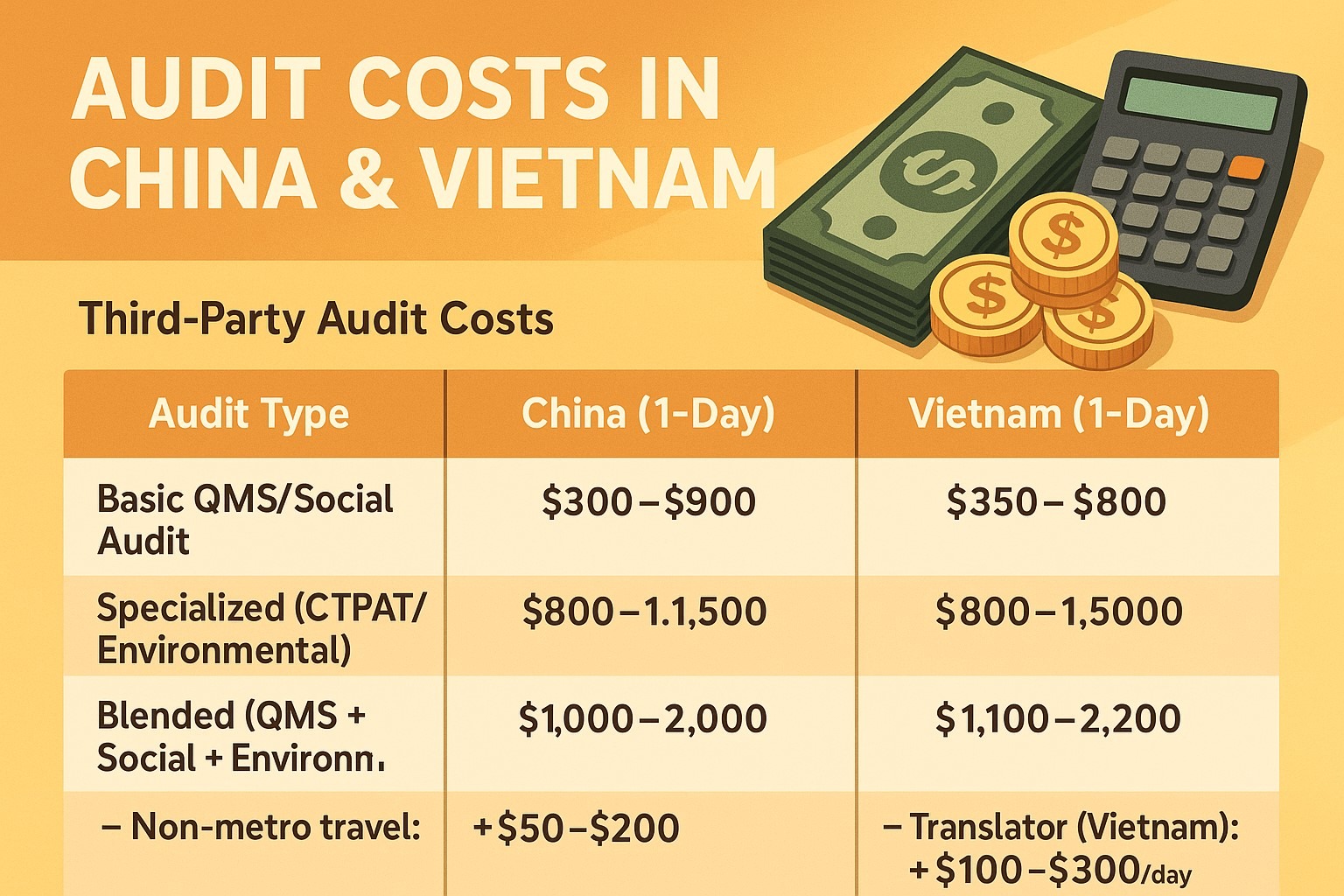
Audit costs vary based on scope, location, and whether you use third-party or in-house teams. Below is a breakdown of typical expenses to help you budget.
10.1 Third-Party Audit Costs
| Audit Type | China (1-Day) | Vietnam (1-Day) | Additional Costs |
| Basic QMS/Social Audit | $300–$900 | $350–$800 | – Non-metro travel: +$50–$200 |
| Specialized (CTPAT/Environmental) | $800–$1,500 | $850–$1,800 | – Translator (Vietnam): +$100–$200/day |
| Blended (QMS + Social + Environmental) | $1,000–$2,000 | $1,100–$2,200 | – Urgent scheduling (≤1 week): +$200–$300 |
10.2 In-House Audit Costs
In-house audits often cost more than teams anticipate, as they include:
- Labor costs: Auditor salaries (e.g., $50–$100/hour) + time spent on pre-audit prep and report writing.
- Travel expenses: Flights (e.g., $800 round-trip from US to Shanghai), hotels ($150–$300/night), and ground transport.
- Hidden overhead: Translators, sample shipping, and follow-up calls.
10.3 Cost-Saving Tips
Bundle audits: Audit multiple suppliers in the same region (e.g., 3 factories in Guangdong) to reduce travel costs.
Use hybrid models: Let third parties handle initial screenings, and reserve in-house teams for high-risk suppliers.
Negotiate annual contracts: Third-party providers often offer discounts for 5+ audits/year (e.g., 10% off for 10 audits).
11. Third-Party vs. In-House Auditors: Which to Choose?
The choice between third-party and in-house auditors depends on your team’s bandwidth, expertise, and risk tolerance. Many businesses use a hybrid model for balance.
11.1 Key Comparison
| Factor | Third-Party Auditors | In-House Auditors |
| Neutrality | High — no vested interest in “passing” the supplier (avoids confirmation bias). | Lower — may overlook gaps to maintain supplier relationships. |
| Expertise | Broad, multi-industry knowledge (e.g., global child labor laws, CTPAT). | Deep expertise in your product (e.g., “how to audit PCB manufacturing”). |
| Scale | Can audit 5–10 suppliers/month (covers China/Vietnam’s vast regions). High coverage fast | Limited by team size (typically 1–2 suppliers/month). Limited by team size |
| Cost | Fixed fee + travel (predictable budgeting). | Salaries + travel + overhead (harder to forecast). |
| Confidentiality | Requires NDAs (to protect your product specs). | Higher — no external parties involved. |
11.2 When to Use Which
- Third-party: New product categories (e.g., sourcing furniture for the first time), wide geographic coverage (e.g., 8 suppliers across Vietnam), or social compliance focus (to avoid bias).
- In-house: Strategic suppliers (e.g., long-term electronics partner), complex products (e.g., custom machinery), or sensitive IP (e.g., proprietary firmware).
12. How Often Should you Re-Audit Suppliers
Re-audit frequency should be risk-based — not tied to a rigid calendar. This ensures you allocate resources to the suppliers that pose the greatest risk.
12.1 Baseline Re-Audit Cadence
| Supplier Risk Level | Re-Audit Frequency | Rationale |
| High-Risk | Every 6 months | Critical parts (e.g., medical device components) or past compliance gaps. |
| Medium-Risk | Every 12 months | Standard parts (e.g., plastic widgets) with consistent performance. |
| Low-Risk | Every 18–24 months | Commodity items (e.g., packaging) with no history of issues. |
12.2 Triggers for Unscheduled Re-Audits
Conduct an emergency re-audit if any of these occur:
- On-time delivery falls below 90% for 2 consecutive months.
- Defect rate spikes above your control limit (e.g., from 1% to 5%).
- CAPA items are missed (e.g., “Supplier failed to calibrate tools by due date”).
- Media reports or industry alerts flag compliance risks (e.g., “Labor violations in Vietnam’s apparel sector”).
13. Tools to Streamline Audits
- The right tools save time, reduce errors, and make audit data comparable across suppliers. Below are four essential tools for China/Vietnam audits:
- Mobile Audit Apps: Apps can let you capture photos (with time/GPS stamps), score items in real time, and generate reports on-site. This eliminates manual paperwork (critical for Vietnam’s remote regions).
- Risk Scoring Spreadsheets: Use Excel or Google Sheets to weight checklist items (e.g., “Child labor check = 15 points”) and calculate total scores. Include formulas to auto-generate “Pass/Fail” ratings.
- CAPA Tracking Tools: Tools like Trello or Asana help you assign CAPA tasks (e.g., “Supplier to fix overtime by 10/30”) and send reminders. Share dashboards with suppliers for transparency.
- Document Management Systems: Cloud platforms like Google Drive or SharePoint let you store audit reports, photos, and CAPA records in one place. Use role-based access to protect sensitive data (e.g., supplier drawings).
Tip: Use the same toolset for China and Vietnam to ensure score consistency. For example, a “Major Nonconformity” in Shenzhen should mean the same as in Ho Chi Minh City.
14. Conclusion & Immediate Next Steps
A structured, risk-weighted factory audit checklist is your most powerful tool for qualifying new suppliers in China and Vietnam. It turns vague promises (“We meet quality standards”) into measurable actions (“Calibrate tools monthly”) — reducing risk and setting the stage for successful partnerships.
14.1 Immediate Next Steps to Implement Audits
- Build your factory audit checklists: Use Section 5 as a template, and tailor questions to your product (e.g., add “RoHS testing” for electronics).
- Tier your suppliers: Classify new suppliers as High/Medium/Low-Risk (e.g., “Vietnamese apparel = High-Risk”) and schedule audits accordingly.
- Finalize your audit model: Decide if you’ll use third parties (for initial screenings), in-house teams (for strategic suppliers), or a hybrid approach.
- Train your team: If using in-house auditors, train them on China/Vietnam’s local laws (e.g., child labor regulations) and interview techniques (e.g., non-leading questions).
By acting now, you’ll turn audits from a compliance chore into a competitive advantage — ensuring your suppliers deliver quality products on time, while protecting your brand and bottom line.
Appendices
- Appendix A: Sample Audit Report Template
- Appendix B: China Labor Law Summary (Key Provisions for Audits)
- Appendix C: Vietnam Labor Law Summary (Key Provisions for Audits)
- Appendix D: AQL Sampling Tables for Final Inspection
Author: AQI Service as a professional quality control service company in China specialized in providing a complete range of quality inspection and testing certification services in China & Asia for global importers, buyers, retailers, and sellers.