Mattress Inspection for Global Sourcing: What Importers and Procurement Teams Need to Verify Before Every Shipment

There’s a gap between what a factory tells you about a mattress and what the mattress actually is. That gap causes real problems: delayed shipments, failed border checks, hotel guest complaints, and procurement disputes that take months to untangle.
This guide is written for people on the buying side: importers sourcing from Asia, procurement managers spec-ing mattresses for hotel chains, and product managers who need to translate factory claims into defensible quality standards. It’s a working document, not a consumer overview.
Why Mattress Inspection Is a Procurement Control Point, Not an Afterthought
Most importers treat inspection as the last step before shipment. It should start when specs are agreed on, not after production is done.
Mattresses are complex composite products. A single unit can contain polyurethane foam, latex, pocket springs, woven fabric, adhesives, fire barrier layers, and decorative stitching. Each material is often sourced from a different supplier, and each carries its own chemical profile and failure mode. The factory assembling the final product often has limited visibility into what’s inside the raw materials it receives.
When you skip systematic inspection, you’re not just accepting unknown quality. You’re accepting unknown risk: chemical non-compliance that surfaces during customs clearance, structural failures that appear after three months of hotel use, or fire safety gaps that violate the terms of a public procurement contract.
A pre-shipment inspection conducted by a qualified third party doesn’t eliminate risk, but it makes risk visible and actionable before goods leave the factory.
Key Testing Areas in a Mattress Inspection Program
Chemical Safety – What’s Off-Gassing in That Container
Chemical testing is where importers most frequently underestimate scope. Formaldehyde gets the most attention, but it’s only one part of the picture.
Formaldehyde emissions are tested using standardized chamber methods, and the specific protocol depends on your destination market. EU buyers typically reference EN 717-1 or equivalent. The US market has moved past CARB Phase 2 labeling on its own: as of March 2019, composite wood components sold or imported into the US must meet formaldehyde emission standards under federal TSCA Title VI, not CARB reciprocity. Checklists still citing CARB Phase 2 as the operative US standard are out of date.
VOCs (volatile organic compounds) are a broader category, analyzed via GC-MS under controlled temperature and humidity. What matters here isn’t just whether VOC levels are detectable – it’s which compounds are present and at what concentrations. Toluene, benzene, styrene, and acetaldehyde each carry different health and regulatory implications.
Heavy metals and restricted azo dyes are relevant to any textile component: the ticking fabric, decorative borders, piping, and even the thread. Substances restricted under REACH Annex XVII are the reference point for EU importers. US buyers should review CPSC guidelines for lead and phthalate restrictions in applicable components.
One thing worth remembering: a mattress that smells fine in the showroom can still have measurable VOC levels. Odor doesn’t tell you whether a mattress is chemically safe.
Flame Retardancy – Where Regulatory Requirements Get Complex
Flame retardancy is probably the most regulation-heavy area in mattress testing, and it’s where non-compliance is most likely to cause serious commercial and legal consequences.
In the United States, CPSC’s mattress flammability guidance confirms 16 CFR Part 1633 sets open-flame performance requirements for residential mattresses, while 16 CFR Part 1632 covers smoldering ignition. These are mandatory federal standards – there’s no workaround.
For hotel and institutional procurement, many buyers layer additional specifications on top of federal minimums. A hotel chain might require compliance with BS 7177 (UK), NF EN 597 (France), or property-specific fire safety standards tied to local building codes.
The testing itself involves controlled ignition scenarios – open flame from a gas burner, smoldering cigarette simulation – and measures flame spread rate, after-flame duration, and char length. Inspectors sample from production lots, not just prototypes. A design that passes prototype testing can fail production testing if the fire barrier material is substituted or improperly applied.
This is a common failure pattern in our project work: the approved sample uses a compliant fire barrier; production uses a cheaper alternative that was never validated. Physical inspection of the production units, including cross-section checks, is the only way to catch this before shipment.
Structural and Mechanical Safety
Structural testing answers a straightforward question: will this mattress remain safe and functional under real use conditions? The failure modes here overlap more than buyers expect with other upholstered products – teams running furniture inspection programs will recognize several of the same stress points.
The key test areas include:
- Edge support under cyclic loading – edges receive disproportionate stress from users sitting on the perimeter, particularly in hotel applications. Inadequate edge reinforcement leads to accelerated sagging and fall risk.
- Internal component stability – pocket spring assemblies, foam layers, and latex cores should be assessed for displacement, delamination, and lateral movement under repeated load cycles.
- Fabric and seam integrity – ticking fabric is assessed for tensile strength and seam burst resistance. Handles, labels, and zipper closures (where present) are checked for secure attachment.
For buyers sourcing mattresses for elderly care facilities, pediatric use, or clinical environments, structural safety testing carries additional weight. Falls and entrapment hazards associated with mattress edge failure or frame incompatibility are documented safety events in these settings.
Comfort and Firmness Verification
“Medium-firm” is one of the most commercially contested terms in the mattress industry. Two factories can label entirely different products with the same descriptor. For buyers spec-ing mattresses at scale – particularly for hotel groups – this creates meaningful variance in guest experience across properties.
Firmness gets quantified through indentation load deflection (ILD) testing for foam components, and through overall surface load-deflection measurements for the finished mattress. Results get mapped against a buyer’s defined comfort specification, giving an objective pass/fail reference instead of a subjective call.
Pressure distribution testing checks how load spreads across the sleep surface under simulated body positions. Buyers sourcing for health-focused hospitality, rehab facilities, and premium residential projects ask for this more often now.
Breathability and thermal comfort testing checks whether a mattress marketed as “cooling” actually performs differently from a standard product under controlled conditions. Air permeability measurements and standardized thermal resistance tests give you numbers instead of a marketing claim.
Durability Testing – The Evidence Behind Warranty Claims
A mattress warranty is only as credible as the durability data supporting it. Accelerated testing compresses years of simulated use into controlled test cycles, measuring permanent deformation, recovery rate, and functional degradation.
Relevant test methods include:
- Foam compression fatigue testing – repeated loading to measure permanent set (how much height is lost and doesn’t come back)
- Spring fatigue testing – cyclic loading on innerspring or pocket spring assemblies to assess loss of support over time
- Fabric abrasion and pilling tests – verifying that ticking fabric maintains acceptable appearance after simulated wear
Durability test data gives buyers a defensible basis for warranty terms. It also gives you leverage when a factory proposes substituting a material mid-production: you can require the substitute to pass the same durability benchmarks as the approved spec.
Mattress Inspection Scenarios – Where Third-Party Verification Adds the Most Value
Pre-Shipment Inspection for Export Orders
Pre-shipment inspection is the most common engagement for importers working with overseas factories. A qualified inspector visits the factory when production is 80–100% complete, checks a statistically valid sample from the production lot, and documents findings against the buyer’s specification.
For mattresses, this typically includes:
- Dimensional verification (length, width, height against contract spec)
- Visual and workmanship assessment (stitching, fabric defects, label accuracy)
- Functional and structure checks (firmness spot-check, edge compression, layer structure check, and noise under movement)
- Sampling for laboratory testing (chemical safety, flame retardancy)
The value is in the timing. Problems caught pre-shipment can be fixed, renegotiated, or rejected before the buyer pays the final balance and before freight costs hit. Problems caught after arrival cost a lot more to fix.
Institutional and Project Procurement
Hotel groups, hospital systems, and education authorities buying mattresses at scale need things a standard import inspection doesn’t cover – a mattress inspection service built around the project’s logistics, not just the product.
Acceptance inspection in these cases usually involves on-site checks at the delivery location, not just at the factory. Damage in transit, wrong models delivered, and packaging failures are real risks in large-volume projects.
In government procurement – education especially – environmental requirements are often stricter than the baseline. Buyers may set internal VOC limits tighter than regulatory minimums, or require documentation of material origin for sustainability compliance. Third-party testing gives you the objective evidence procurement rules require.
In-Use and Dispute Assessment
When a buyer or end-user finds a problem with mattresses already in service – sagging after six months, a persistent chemical smell, suspected structural failure – third-party inspection provides the technical evidence needed to find the root cause and assign responsibility. It pairs well with a periodic factory audit when the pattern points to a process change rather than a one-off bad batch.
This matters in warranty claims and commercial disputes. An inspection report documenting non-conformance against the original contract spec holds up far better in negotiation or arbitration than a photo and a complaint email.
A Structural Inspection in Practice
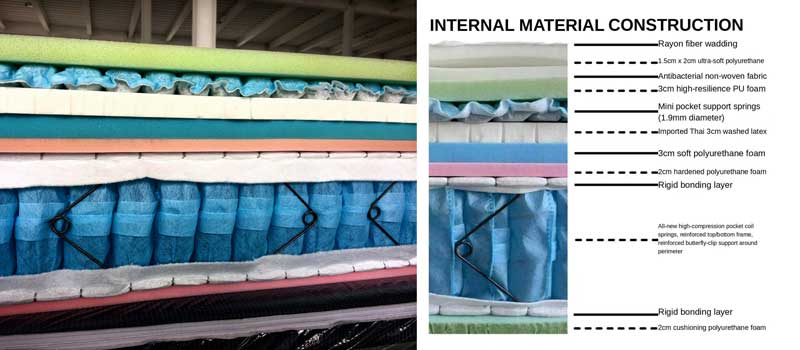
Spec problems rarely show up as one obvious defect. They usually show up as several small differences you only catch once you open the mattress up. On one recent order, AQI SERVICE inspectors working from the buyer’s own construction specification found four separate points where production had drifted from what was approved.
- The branded logo was supposed to appear on every unit; only half the sampled pieces actually had it stitched on.
- Deeper in the construction, the spec called for a 2cm layer of pink foam – production had used a 3cm layer in a different color instead, which changes both the feel and the cost basis the buyer had approved.
- The mattress’s side panel was specified with a zipper closure; the units on selected samples had none.
- The mini pocket steel spring wire, specified at 1.9mm in diameter, measured 1.44mm under caliper – easy to miss by eye, but significant for long-term support and sag resistance.
None of these four issues would necessarily fail a mattress on sight. A buyer doing a surface check – corners squared, stitching neat, firmness roughly right – could sign off on the shipment without catching any of them. Catching them took cutting into the layers, measuring wire diameter with calipers, and checking material against the buyer’s own reference sample instead of a general impression of “looks like a mattress.” Whether the check happens mid-production or pre-shipment, this kind of structural verification is what actually catches drift. A surface pass tells you very little about what’s inside.
Common Misconceptions That Create Risk for Buyers
“The factory passed last year’s audit, so quality is consistent.”
Audits check management systems, not product performance. Material substitutions, supplier changes, and process drift can happen between audits without tripping any audit finding. Inspecting actual production isn’t a substitute for an audit, and an audit isn’t a substitute for inspection.
“We have a test report from the factory.”
Reports from non-accredited or factory-affiliated labs carry limited weight in regulated markets. Ask for reports from ILAC-accredited laboratories using relevant, current test methods. Check that the lab’s accreditation actually covers the specific tests cited, not just testing in general.
“The sample passed, so the production run is fine.”
Prototype and pre-production sample testing doesn’t predict production lot quality. Material availability, cost pressure, and process shortcuts during a full production run can produce different results than a carefully prepared sample. Check the production lot, not just the sample.
“Only chemical safety matters for our market.”
Structural safety and durability are equally real commercial risks. A mattress that passes chemical testing but fails structurally within a hotel’s warranty period still costs you in warranty claims, reputation, and liability. A clean chemical report won’t cover any of that.
Standards Reference for Importers
Buyers working across markets need to navigate multiple overlapping frameworks:
| Market | Fire Safety | Chemical / Material |
|---|---|---|
| US | 16 CFR 1632 (smoldering ignition), 16 CFR 1633 (open flame) | TSCA Title VI (formaldehyde), CPSC lead/phthalate guidelines |
| EU | Country-specific fire standards | EN 1957 (geometric characteristics), REACH Annex XVII |
| UK | BS 7177 (resistance to ignition) | BS EN 1957 |
| Hotel and contract | Buyer-specified, layered on national requirements | Buyer-specified, often tighter than baseline |
The International Sleep Products Association tracks how these frameworks shift across markets – worth a periodic check if you’re sourcing for more than one destination country. A third-party inspection provider that knows which standards apply in your destination market, and can route samples to accredited labs accordingly, is a different level of service than a generic inspection.
What to Expect from a Qualified Mattress Inspection Partner
A credible inspection firm has relevant technical knowledge, access to accredited laboratory testing, and experience with your destination market’s regulations.
On the technical side, inspectors should be able to cross-section a mattress to verify internal construction and identify material substitutions against approved specifications. That means conducting meaningful on-site functional checks – not just counting units and checking labels.
On the lab side, the firm should work with ILAC-accredited labs and be upfront about which accreditation covers which test methods. Reports should state the test method used, the applicable standard, and the result against the specified limit – clearly, not buried in an appendix.
At AQI Service, our mattress inspection programs are built around the buyer’s specification and the destination market’s requirements, not a generic checklist. We handle pre-shipment inspection, production monitoring, and project-based acceptance inspection, with lab sampling routed to accredited facilities appropriate for your target market.
Building Mattress Inspection Into the Procurement Workflow
A pre-shipment inspection costs a small fraction of what a rejected shipment, a warranty dispute, or a failed compliance audit costs. For buyers sourcing mattresses at any real scale, the question isn’t whether to inspect – it’s how to build inspection into the process systematically.
Set your acceptance criteria before production starts. Require production-lot sampling, not just prototype testing. Use accredited lab results as your reference, not factory-supplied documents. Treat inspection findings as data to act on, not a final verdict.
That’s the difference inspection makes: catching problems while they’re still cheap to fix, instead of after the container’s already on the water.