Physical and Mechanical Testing: What Importers Need to Know Before Approving a Supplier’s Materials

Induction
Physical and mechanical testing is one of those areas where importers often defer entirely to their suppliers – and that deference is where quality problems begin. A supplier says the steel meets your tensile strength requirement. The plastic housing passes their internal hardness check. The coating bond strength is fine. You take their word for it, the goods arrive, and three months into the product lifecycle, failures start coming in.
The problem isn’t always that suppliers are dishonest. It’s that in-house testing at a factory has an obvious conflict of interest, and without independent verification, you have no way to distinguish a supplier with rigorous material controls from one cutting corners on raw material quality.
This guide covers what physical and mechanical testing actually measures, which tests are relevant to common import product categories, and how independent material testing fits into a quality control process for importers sourcing from Asia.
Why Material Properties Matter More Than Visual Inspection
Visual inspection – checking dimensions, surface finish, color, and workmanship – catches a large proportion of quality defects. But it tells you nothing about how a material will perform under stress, over time, or in the conditions your customers will actually use the product.
A plastic component can look identical to spec and still have inadequate impact resistance because the supplier substituted a lower-grade resin. A metal fitting can pass dimensional checks and fail under the load requirements your product is designed for. A coating can look uniform and still delaminate after six months of normal use.
Physical and mechanical testing addresses these invisible properties. It’s the difference between knowing what your product looks like and knowing how it will perform.
Destructive vs. Non-Destructive Testing
Physical and mechanical tests fall into two broad categories, and the distinction matters for how testing is integrated into production.
Destructive testing involves applying force or stress to a sample until it fails or deforms. The test provides precise data on material properties, but the tested sample is consumed in the process. Tensile testing, impact testing, and fatigue testing are all destructive. For incoming material inspection, this means testing a sample from each batch – not every unit.
Non-destructive testing (NDT) evaluates material properties without damaging the sample. Hardness testing (in most applications), ultrasonic testing, and certain coating assessments fall into this category. NDT is more practical for finished product inspection, where you need to verify properties without destroying sellable goods.
For most importers, the practical approach combines both: destructive testing on raw material samples at the start of production to verify the supplier’s materials meet spec, and non-destructive checks at the finished goods stage.
The Main Types of Mechanical Testing
-
a. Tensile Testing
Tensile testing measures how much pulling force a material can withstand before it deforms permanently or breaks. The test applies controlled tension to a standardized sample and records the force at yield (where permanent deformation begins) and ultimate failure.
For importers, tensile strength is relevant wherever structural integrity matters: metal components in furniture or hardware, straps and webbing in bags and safety equipment, woven fabrics under load, plastic components in products that bear weight or absorb force.
The output of a tensile test includes yield strength, ultimate tensile strength, elongation (how much the material stretches before breaking), and modulus of elasticity (stiffness). A Universal Testing Machine is the standard equipment; results should reference the applicable test standard (ASTM E8 for metals, ISO 6892, or category-specific standards).
-
b. Hardness Testing
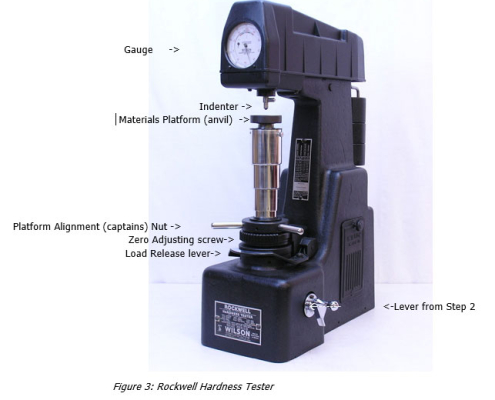
Hardness measures a material’s resistance to surface indentation or scratching. It’s one of the most frequently specified mechanical properties because it correlates with wear resistance, machinability, and response to heat treatment.
Three methods are most commonly used:
Brinell Hardness Test (BHN) uses a spherical indenter and is suited to large components and softer metals. It’s not appropriate for thin materials or very hard surfaces.
Rockwell Hardness Test (HRC/HRB) provides a direct numerical reading and is fast and flexible. Rockwell B uses a ball indenter for softer materials; Rockwell C uses a diamond cone for hardened steels. It’s the most widely used method in manufacturing QC.
Vickers Hardness Test (HV) uses a square pyramid diamond indenter and works well for small samples, thin materials, and very hard surfaces where Brinell and Rockwell aren’t appropriate. It’s also used for surface hardness measurement after heat treatment or coating.
Choosing the right hardness test depends on the material type, component size, required accuracy, and whether compliance with a specific standard is required. When reviewing a supplier’s hardness test report, confirm that the method used is appropriate for your material and that the result is reported against the correct scale.
-
c. Impact Testing
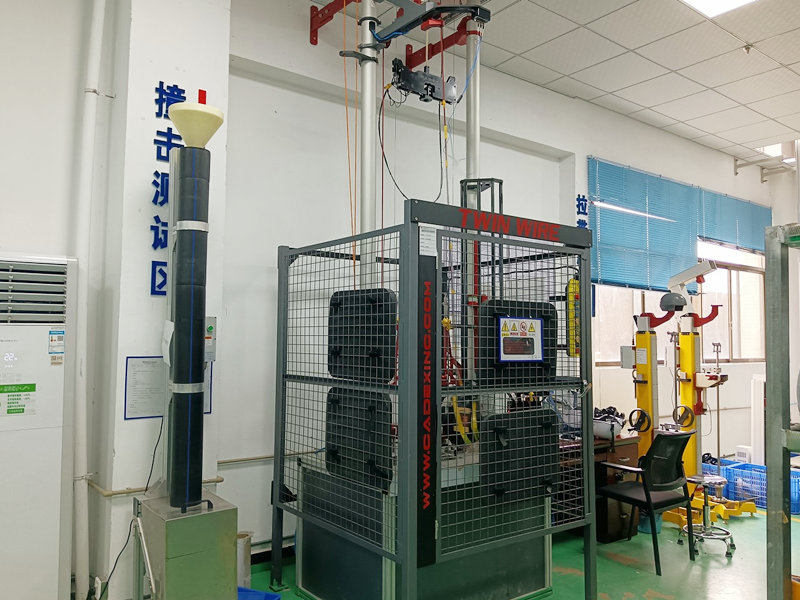
Motorcycle Helment Product Impact Testing
Impact testing measures toughness – the ability of a material to absorb energy during a sudden load, rather than a gradual one. This is distinct from tensile strength; a material can be strong under steady load but brittle under impact.
The two standard methods are the Charpy test (sample supported at both ends, struck in the middle) and the Izod test (sample clamped vertically, struck at the free end). Both measure the energy absorbed during fracture.
Impact testing is particularly relevant for products subject to dropping, collision, or sudden force: tools, protective equipment, automotive components, outdoor furniture, and children’s toys where impact resistance is a safety requirement.
-
d. Fatigue Testing
Fatigue testing determines how a material behaves under repeated cyclic loading – stress applied and released over many cycles. Materials can fail at stress levels well below their tensile strength when that stress is applied repeatedly over time. This is fatigue failure, and it’s responsible for a significant proportion of real-world product failures that aren’t caught by static strength tests.
Fatigue testing is most relevant for components that experience repeated mechanical stress in use: hinges, fasteners, handles, wheels, springs, and structural elements in products used daily. The output is typically an S-N curve (stress vs. number of cycles to failure) that allows designers and buyers to assess expected service life under defined conditions.
For importers, fatigue testing is most commonly required during product development and supplier qualification rather than on every production batch – but it’s the test that provides the most realistic prediction of how long your product will actually last.
Physical Properties and Why They Matter for Product Performance
Beyond mechanical properties, physical testing covers how materials respond to environmental conditions: temperature, electrical load, and volume changes. These properties are relevant to product performance and, in many cases, to regulatory compliance in your target market.
-
Thermal Properties
Thermal conductivity – How efficiently a material transfers heat. Relevant for electronics (heat dissipation), cookware, and insulation products.
Thermal expansion – How much a material changes dimensions with temperature change. In products with multiple materials or tight tolerances, mismatched thermal expansion coefficients cause cracking, loosening, or failure at temperature extremes. This is frequently a root cause of field failures in electronics and metal-plastic assemblies.
-
Electrical Properties
Conductivity and resistivity are relevant for any product with electrical components. Materials used as insulators need to be verified as actually insulating; conductive pathways need to meet resistance specifications. These properties also affect compliance with electrical safety standards (UL, CE, and others) required for your target market.
-
Density and Melting Point
Density verification catches raw material substitution. A supplier who switches to a cheaper alloy or lower-grade resin may produce parts that look identical but have measurably different density. A simple density check on incoming materials is one of the fastest ways to detect material substitution before it becomes a production problem.
Melting and softening point is relevant for polymers and adhesives, particularly for products that may be exposed to elevated temperatures in use, storage, or transport.
Which Tests Apply to Common Import Categories
Rather than testing everything, the practical approach is to identify which mechanical and physical properties are most likely to affect product performance or compliance in your specific category.
- Metal components (hardware, furniture, tools, automotive parts) Tensile strength, hardness, and impact resistance are the core tests. Coating bond strength and corrosion resistance (salt spray testing) are typically also required. Test standards: ASTM or ISO equivalents depending on target market.
- Plastics and polymer components Tensile strength, flexural strength, impact resistance (especially at low temperatures for products used outdoors), and hardness. For food-contact plastics, migration testing is a separate regulatory requirement. Test standards: ASTM D-series or ISO 527/178/180.
- Textiles and flexible materials Tensile and tear strength, seam strength, and abrasion resistance. For load-bearing textiles (straps, webbing, safety harnesses), minimum breaking strength is a defined regulatory requirement in most markets.
- Electronics and electrical components Electrical resistivity and conductivity of insulating materials, thermal performance of heat-dissipating components, and mechanical testing (vibration, drop) for housings and connectors.
- Rubber and elastomers Hardness (Shore A/D), tensile strength, elongation at break, and compression set. Relevant for seals, gaskets, footwear soles, and any application requiring elastic recovery.
How Material Testing Fits Into Pre-shipment Inspection
Laboratory material testing and pre-shipment inspection serve different functions and should be sequenced accordingly.
Material testing – tensile, hardness, impact, and similar tests – is most valuable at two points: during supplier qualification (to verify that a new supplier’s materials meet your specifications before committing to production) and at the start of a new production run (to confirm that the materials being used are consistent with what was approved).
Pre-shipment inspection, conducted when goods are complete and ready to ship, verifies that the finished product meets visual, dimensional, and packaging requirements. It includes random sampling and workmanship checks, but it’s not designed to verify material properties – those need to be confirmed earlier in the process.
The combination is what provides comprehensive coverage: material testing confirms what your product is made of, pre-shipment inspection confirms that the final goods are complete and correctly prepared. Running only one of these checks leaves a gap.
When material testing is required as part of your quality program, AQI SERVICE can coordinate with accredited third-party laboratories to arrange testing on samples drawn from your production batch, with results referenced to the applicable standards for your target market.
Working With AQI SERVICE on Material Testing and Quality Control
AQI SERVICE provides pre-shipment inspection, factory audit, and quality control coordination for importers sourcing from China and across Asia. For customers who require material testing as part of their supplier qualification or production quality program, we work with accredited laboratories to arrange physical and mechanical testing and incorporate results into the overall quality documentation for your shipment.
If you’re sourcing products where material performance is a critical quality or compliance factor, contact us to discuss how material testing can be integrated into your inspection program.
Related:
4 Steps Amazon FBA Sellers Should Not Skip When Sourcing in China
How to Choose Alibaba Trusted Suppliers & Tips for Minimizing Product Defects
What’s The Most Suitable Inspection? PSI Inspection or 100% Inspection?
5 Critical Packaging Quality Control Elements Importers Should Not Skip
Author: AQI Service as a professional quality control service company in China specialized in providing a complete range of quality inspection and testing certification services in China & Asia for global importers, buyers, retailers, and sellers.