Sourcing Agents and Quality Control: How Smart Importers Use Both to Protect Every Shipment

A few months ago, one of our customers reached out with a familiar problem. He’d been using the same sourcing agent for two years, had good communication, reasonable prices, and no major issues – until a container arrived in Los Angeles with roughly 8% of the units either damaged or not matching the approved sample. His agent had visited the factory and said everything looked fine.
Nobody was lying. That’s the thing. The agent genuinely believed the shipment was acceptable. The factory believed it too. But “looked fine” and “passed inspection” are not the same thing, and that gap ended up costing our customer about $14,000 in replacements and a lost retail account.
This situation comes up more than most importers realize, and it’s almost never about bad intentions. It’s about two very different jobs getting mixed up into one.
What a Sourcing Agent is Actually Hired to Do
When you work with a sourcing agent – or a sourcing company, or any kind of buying office – wISOhat you’re really paying for is access and relationships. They know the factories. They speak the language. They understand which suppliers are reliable for your product type and which ones will tell you what you want to hear until the goods are on a boat.
That knowledge is genuinely hard to replicate from overseas, and a good agent earns their fee many times over in time saved, price negotiations, and problems avoided before they even start. The value is real.
What’s also real is that their job is built around maintaining those supplier relationships. That’s not a conflict of interest in the usual sense – it’s just how the work functions. An agent who burns bridges with factories can’t do their job.
So when they visit a production line and something looks borderline, the pressure they’re under is different from what an independent inspector faces. The inspector has no relationship with that factory to protect. They will never see those people again after they file their report.
The Practical Difference Between a Quality Check and a Quality Inspection
This is where a lot of importers get tripped up, and it’s worth being specific about.
When a sourcing agent does a quality check, it typically means walking through the factory, looking at finished goods, opening some boxes, and forming a general impression. That impression is often accurate. But “often accurate” and “systematically verified” are different standards, and the difference matters when you’re deciding whether to release a six-figure payment.
A professional pre-shipment inspection works differently. Before the inspector arrives, a sampling plan is established using AQL standards – a method that determines exactly how many units need to be checked based on order size and acceptable defect thresholds. Every defect found gets classified as critical, major, or minor, with predefined acceptance numbers for each category. Everything is photographed. The final report shows pass or fail against criteria that were set before the inspector walked in the door – not after.
The reason that structure matters: it removes judgment calls from the process. An agent deciding whether a shipment is “good enough” is making a subjective call under pressure. An inspector running an AQL-based inspection is following a protocol with a predetermined outcome. You either hit the acceptance number or you don’t.
It also creates documentation. If your shipment arrives with problems and you need to go back to the supplier, an inspection report with timestamped photos taken at the factory is your strongest evidence. A message from your agent saying the goods looked okay is not.
Where the Two Roles Actually Fit Together
The mistake most importers make isn’t using a sourcing agent – it’s assuming the agent’s involvement covers the full picture. It doesn’t, and it’s not supposed to.
Think of it as two separate stages.
Your sourcing agent handles the upstream side: finding the right factory, negotiating terms, placing the order, chasing the production timeline. They’re your representative in a market you can’t easily access yourself, and they’re good at it.
Third-party inspection handles the downstream verification: confirming that what actually gets produced and loaded into the container matches what you ordered and approved. That’s a different function, and it needs to be independent to mean anything.
In practice, the two work alongside each other without much friction. Your agent coordinates factory access for the inspection – they usually have the contact and can arrange it faster than you can from overseas. The inspector shows up, runs the protocol, and sends you a report. The agent and the inspector never need to conflict because they’re not doing the same job.
Where importers run into trouble is when they treat these two functions as interchangeable – assuming that because their agent visited the factory, a formal inspection isn’t necessary. For small, low-value orders with a factory you’ve used for years, that might be a reasonable risk to take. For anything significant, it’s a gap that tends to close itself at the worst possible time.
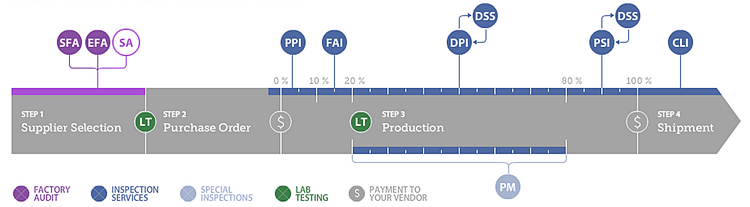
How the Sourcing Agent Work Together with Third Party Inspection
The way to think about it: your sourcing agent handles everything before the goods are made, and your inspector verifies everything after. They’re not doing the same job – they’re covering different stages of the same process.
Here’s what that looks like across a typical import order:
Supplier qualification
– Your sourcing agent identifies factories and recommends one based on their knowledge of the market. An independent factory audit verifies the factory’s actual production capacity, equipment, and quality systems before you commit to an order. Your agent knows the factory’s reputation; the audit tells you what’s actually on the production floor.
Pre-production
– Your sourcing agent places the order and tracks the timeline. For products with strict material requirements – children’s products, electronics, anything with specific compliance needs – a pre-production inspection confirms that raw materials and initial components match your specifications before the factory is too far into production to change course.
During production
– Your sourcing agent follows up on progress. A during-production inspection at around 30–50% completion checks product quality against your spec while there’s still time to fix problems. Catching an issue at this stage is far cheaper than catching it at pre-shipment.
Pre-shipment
– This is the most important checkpoint. An independent pre-shipment inspection checks product quality, packaging, labeling, and quantity against your purchase order. It happens after production is complete and before the goods leave the factory – regardless of what the factory’s own QC team says passed.
Container loading
– For larger orders or fragile products, a container loading supervision confirms goods are loaded correctly, the right quantity goes in, and the seal is applied in front of the inspector.
The sourcing agent and the inspection company don’t duplicate each other’s work in this model. They cover different parts of the process.
A Word to Sourcing Agents Reading This
Most experienced sourcing agents already recommend independent inspection to their clients. The ones who’ve been in the business long enough have seen what happens when they don’t.
Taking on quality control as part of your service isn’t just a liability issue – though it is that too. It’s a credibility issue. When you inspect your own recommended factory and sign off on the quality, your client has no independent verification that the result wasn’t influenced by the relationship. When an outside inspector signs off, that result means something different. It’s cleaner for everyone.
It also protects you in ways that matter. Factories change. A supplier who was consistent for two years can have a bad production run. If an independent inspector catches it, you’re protected. If you were the one who cleared the shipment and something’s wrong, the conversation with your client is a much harder one.
Recommending third-party inspection isn’t an admission that you can’t handle quality – it’s a sign that you understand how the process should work. Most sophisticated importers see it that way.
Choosing the Right Inspection Partner
Not all inspection companies are set up to work well alongside a sourcing agent relationship. A few things worth checking before you commit:
Can they actually reach your factories?
This sounds basic but matters. If your sourcing agent works with suppliers spread across Guangdong, Zhejiang, and Fujian – or across multiple countries – your inspection company needs inspectors in those locations, not just a central office that dispatches people on a few days’ notice. Ask specifically where their inspectors are based.
Do they know your product category?
A company that mostly inspects garments will approach an electronics inspection differently than one that specializes in it. Ask for examples of inspection reports from your product category, not just general credentials.
What does their report actually look like?
Ask for a sample report before you hire anyone. A good inspection report has a clear pass/fail result, photos of every issue found, defect classification by severity, and specific details about what failed and why. If the sample report is vague or light on photos, the actual report will be too.
Can they work with your sourcing agent on scheduling?
Your sourcing agent will usually be the one coordinating factory access for the inspection. An inspection company that’s used to working this way – communicating directly with the factory contact your agent provides – makes the whole process smoother than one that needs the importer to manage every handoff.
Frequently Asked Questions
My agent says quality control is part of their service. Do I still need independent inspection?
Ask what that actually includes. Specifically: do they have the QC inspection checklist? how many units do they check, how do they decide, and can you see a sample report from a previous inspection? If the answers are vague, the service is informal. An agent’s quality oversight can be a useful early signal, but it’s not a substitute for a structured pre-shipment inspection before you release final payment – especially on larger orders.
Do I need to tell my agent I’m hiring an inspector?
Yes, and just be direct about it. Agents who work with serious importers expect this. Frame it as a standard part of your process. If an agent is uncomfortable with an independent inspector visiting their recommended factory, that discomfort itself tells you something worth knowing.
Can my agent handle the logistics of scheduling the inspection?
Usually yes, and it’s often easier that way. Your agent has the factory contact and can coordinate timing faster than you can from a different time zone. The inspection stays independent regardless – logistics coordination doesn’t affect what the inspector finds or how it gets reported.
Is inspection worth it on smaller orders?
A pre-shipment inspection typically runs $300–$500. On a $5,000 order that’s a meaningful percentage. On a $20,000 order, it’s the cost of catching one production problem before it ships. Most importers who’ve had a significant quality failure don’t ask this question twice.
Working With AQI SERVICE
We work alongside sourcing agents regularly – it’s a normal part of how cross-border sourcing operates. Our inspectors are based across China, Vietnam, India, and other manufacturing regions, and we coordinate directly with factory contacts that sourcing agents provide.
Our inspection reports are in English, delivered within 24 hours, and built around AQL sampling standards with full photographic documentation. Whether you’re running a factory audit before a first order, a mid-production check, or a pre-shipment inspection before the container loads, the process is the same: clear criteria established upfront, findings documented objectively, pass or fail reported without ambiguity.
For sourcing agents looking to recommend a reliable inspection partner to their clients, or for importers building inspection into an existing sourcing agent relationship, contact us at aqiservice.com.
AQI SERVICE is an independent third-party inspection company serving importers and sourcing professionals worldwide.