How a Supplier QMS Audit System Reduces Late-Stage Inspection Failures?

Why a Supplier Quality Management System Audit is Important
Quality issues that are discovered in manufacturing or global sourcing at the final inspection are almost invariably more costly than they need to be. At that point, the products are made, packed, and waiting to be shipped — which means the only options are rework, reject, or send down stream to ship bad product and deal with the fallout.
A supplier QMS audit system changes that dynamic. It doesn’t wait to see if a supplier actually produces good product, it looks to see if the supplier has the necessary controls to produce good product on a consistent basis. Here is a more meaningful question, and one that third party quality control companies such as AQI SERVICE are designed to answer for you , your importers and procurement teams.
The Hidden Cost of Early-Stage Failures
You get that inefficiency with quality issues later in the production process. Rework and scrap are the visible part. Add expedited freight to make up for lost time, contract penalties for late delivery, emergency re-sourcing at unfavorable terms, and the management time spent on crisis management – and the overall cost of a single bad batch can be eight to 10 times what it would cost to catch the same problem upstream.
An advanced supplier QMS audit program allows you to uncover inadequate process controls before they result in defective product. Companies that conduct supplier quality audits routinely tend to report late stage inspection failure rates dropping by more than 60%, accompanied by a dramatic reduction in overall quality costs.
Establishing More Stable Supplier Sourcing
supplier QMS audit system can also be used as a supplier selection and classification tool. Run it through your supply base and you get tangible data on which suppliers have robust quality management and which don’t. This information fuels better sourcing decisions: transfer volume to qualified suppliers, place underperforming suppliers on improvement plans, and eliminate relationships that represent excessive risk before a quality incident forces the decision.
Over time, this transforms the supplier base into one in which quality expectations are both communicated and understood — and not just something that gets checked at shipment.
Compliance and Brand Protection
Regulatory and customer expectations have extended well beyond the OEM in most industries. Standards like ISO 9001, IATF 16949 (automotive), ISO 13485 (medical devices) and ISO 22000(food safety) increasingly require that quality management extends to the supplier level. A supplier QMS audit system aligned with relevant standards gives importers a documented evidence trail for customer audits, reduces exposure to recalls and regulatory action, and provides a defensible position when upstream quality issues arise.
Core Architecture of a Supplier QMS Audit System
The supplier QMS audit system – The supplier relationship lifecycle is also covered in this supplier QMS audit system – starting with the initial supplier qualification and evaluating their ongoing performance and improvement. There are five building blocks.
Step 1 – Define Audit Objectives and Scope
Be clear on exact what you are trying to accomplish and which suppliers are included before your audit takes place. Typical objectives are to decrease late-stage inspection failure rates, detect and mitigate quality risks, develop a stable supplier base, and so on while remaining compliant with applicable regulations.
Typically the following three dimensions scope is described with defining:
- By supplier importance:Core suppliers with critical components get full comprehensive audits as a full visit to them. Important suppliers get focused audits on higher-risk processes. General suppliers may be covered by checklists or document reviews that are less rigorous.
- By lifecycle stage:Pre-qualification audits assess whether to engage with a supplier in the first place. Routine audits monitor ongoing performance. Incident-triggered, extraordinary, process change or defect rate increase.
- By process coverage:quality policy, purchasing and incoming inspection, manufacturing, testing, nonconformance management, CAPA (corrective and preventive action) and continuous improvement.
Defining the scope correctly at this point prevents audit resources from being spun out too thin and ensures the greatest risk relationships receive the greatest attention.
Step 2 – Create a Structured QMS Audit Checklist System with Customized Elements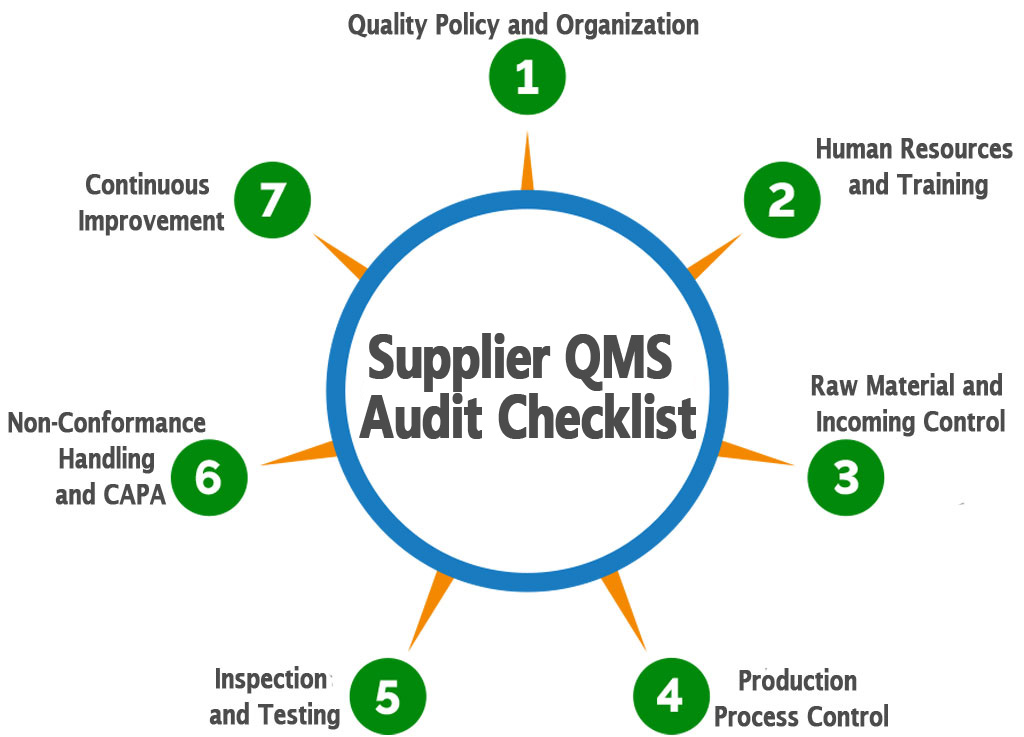
The audit checklist serves as the cornerstone of the supplier QMS audit system. It should be broad enough to address real risk, scored so the results can be compared across suppliers, and customized for the particular products and processes under consideration. A standard checklist used to rate all kinds of suppliers returns numbers without insights.
-
Quality Policy and Organization
Verify the quality objectives are documented, measured and actually reviewed, not simply printed out and posted. Determine whether the quality department has the independence and power to raise concerns without the commercial pressure to ship. A 95% target attainment on quality objectives is a fair expectation. If the supplier is unable to share their current rate, that in itself is a finding.
-
Human Resources and Training
They’re are the quality systems. Ensure that quality supervisors and quality inspectors are properly qualified, that training is conducted on a regular basis (for front line via a minimum of quarterly) and that there is some means of evaluating training effectiveness. Training documentation with no competence evaluation are the records of a training program, but they don’t constitute a program of training.
-
Raw Material and Incoming Control
Much of the finished product’s defects come from the incoming materials. Review how the supplier qualifies its own vendors, what sampling plans are utilized at incoming inspection, the manner in which non-conforming lots are managed, and if there is traceability from finished product to individual raw material lots. It’s worth looking closer at any incoming acceptance rate below 99.5%. There is no traceability – it is a structural gap.
-
Production Process Control
Concentrate here on the majority of observed findings in this audit. The work should be done on the floor (instructions followed, not just put on a binder). Equipment calibration and maintenance are to be up-to-date – On-time calibration of 100% is attainable and a realistic objective. For key characteristics, process capability data (Cpk ≥ 1.33) tells you more than pass/fail records. Pay particular attention to how process deviations and engineering changes are handled: undocumented changes are among the most common root causes of batch-level quality failures.
-
Inspection and Testing
Ensure measuring devices are calibrated and suitable for the tolerances required. A written definition of the acceptance criteria should be established for each type of product. The final inspection has to be a real 100% coverage — don’t type a number and take a few errors here and a few errors there. The nonconforming product should be segregated physically, not only labeled and left in the delivery room.
-
Non-Conformance Handling and CAPA
How a supplier handles defects reveals more about their quality culture than almost any other part of the audit. The questions that matter: Is root cause analysis systematic, or does it consistently land on ‘operator error’? Do corrective actions address the root cause or just the symptom? Is there follow-up to verify the fix worked? A CAPA (Corrective and Preventive Actions) closure rate of 95% or above with documented recurrence tracking is a workable benchmark. Repeated occurrence of the same defect type with different CAPA numbers is a system generating paperwork rather than improvement.
-
Continuous Improvement
The internal audit frequency is twice per year but the actual performance must be “audited” by the Management Reviews and not only be asked if the meeting was conducted. Look for signs of formal improvement activity — Lean or Six Sigma projects, or more simple Kaizen work — and ask about customer complaint resolution. Suppliers with commitments to downstream customers are held to a minimum 24-hour response.
Step 3 – Standardize the Audit Process
Standardization of the audit process is what makes supplier QMS audit results comparable from supplier to supplier and actionable over time. Most programs manage to operate in the five-stage process.
-
Audit Initiation
Caused by events such as new supplier onboarding, a periodic scheduled review, or an incident. Quality team leads – In some smaller company set ups you would expect that the quality lead would or could take this up, in others you will have the procurement and technical teams contributing.
-
Audit Preparation
Identify the scope, objectives, and team prior to on-site. Review existing documentation- quality manual, procedures, previous audit findings, recent inspection reports. Verify schedule and scope expectations with the vendor in advance. Preparation dictates which fields of activity will be examined by an audit; preparation-less tends to gloss over everything and analyze nothing.
-
On-Site Execution
Begin with a short meeting to verify the scope and logistics. Then merge document review, process walkthrough and direct discussion (including with operators and line supervisors, not just the quality manager). As you go, categorize issues as either minor or major based on predetermined thresholds. Remote audits via video are the same format when on-site is not permitted.
-
Scoring and Reporting
Determine the grade for each section in the checklist by calculating a weighted index and also decide on an overall supplier grade – A through D is the most typical scale. Record the results with specific references to evidence. ‘Calibration records are missing for three of six measuring instruments’ is an issue. ‘Calibration process needs improvement’ is not one. Root cause hypotheses, actionable improvement recommendations (rather than a simple score), etc. should be part of the response.
-
Follow-Up and Closure
The supplier responds with corrective action plan with named owners and deadlines. Audit team confirms execution - not just receipt of a document, but an actual change in condition. The supplier grade has been updated based on closure status. Based upon the revised grade, the following audit cycle audit frequency is determined.
Step 4 – Build a Capable Audit Team
The quality of an audit is dependent on the auditor(s). Team members need to be familiar with quality management system concepts, industry, and product type-specific standards. Experience in manufacturing, engineering, or testing counts for more than just having an audit certification on paper. The team needs to be cross-functional from quality, procurement and technical including those that know what a process failure really looks like on the line and not just what it says in a management system doc.
Frequent case discussions, sharing findings with other auditors, and periodic calibration meetings contribute to maintaining consistency and quality within the team for assessing over Time.
Step 5 – Use Digital Tools to Scale the System
Manual, spreadsheet-based auditing systems can function for a while, but eventually they frustrate. As the supply base expands, a digital layer brings centralized audit planning and scheduling, online document submission and review, mobile data capture in the field, automated scoring and report generation, real-time corrective action management, and dashboards that highlight systemic issues among the supply base.
For importers who must show that they have done supply chain due diligence for their customers or regulators, a digital auditing system delivers proof that a folder full of PDF reports cannot. Transparency, traceability – these aren’t nice-to-haves any more, they’re must-haves.
Turning Audit Results into Supplier Strategy
Only when you act on the audit data will it become useful Two applications matter most.
Supplier Classification and Differentiated Management
Approximately, split the supplier base into four blocks according to the audit scores and production performance record:
- Grade A – Strong systems, stable performance, clear improvement culture. These suppliers get priority order allocation, longer contract terms, and involvement in co-development where relevant.
- Grade B – Generally capable with localized weaknesses. Normal commercial relationship plus specific improvement requirements on identified gaps.
- Grade C – Significant system gaps with real risk. Reduced order volumes, more frequent audits, improvement plans with hard deadlines.
- Grade D – Systemic failures at an unacceptable level. Cooperation suspended or terminated unless major changes are demonstrated and verified independently.
This categorization leverages audit results into a purchasing lever. Buyers and category managers who know which suppliers reside in which tier will make sourcing decisions that won’t create quality nightmares later in the season.
Closed-Loop Corrective and Preventive Action
A Nibrate the audit that yields findings but does not follow up on them is an audit you paid for that resulted in nothing productive. The CAPA loop is what turns the findings into actual improvement:
- Each finding includes a clear description that is specific enough to allow the supplier to find and reproduce the condition.
- Root cause analysis not stopping at ‘operator error’ – the cause of the cause.
- Agreed upon actions with named owners and achievable deadlines.
- Confirmation of implementation of actions and change in condition – not just submission of a document.
- Statistical monitoring of recurrence – when the same defect is coming back with a different CAPA number is a red flag, not a closure.
Reporting on supplier performance to include CAPA data – rather than leave it isolated in a quality silo – will allow procurement to see which suppliers really are improving, as opposed to simply cycling paperwork.
Keeping the Audit System Current
A supplier QMS audit program that was developed 2 or 3 years ago and has not been revised may no longer address the real risks in your supply chain. An annual assessment of the system itself··not just audits of individual suppliers should address:
- Changes in applicable standards: ISO 9001, IATF 16949, ISO 13485, ISO 22000, or others relevant to specific product categories
- Changes in the products that make different suppliers and processes critical
- Differences types of failures or defects detected in inspection data or customer complaints
- Constructive feedback from auditors and suppliers on measures that are not resulting in meaningful differentiation
When the figures tell a different story, the audit measures and weights should be revised so that they no longer evaluate the same aspects. Checklist is forever standing still is compliance dance, not quality system. Deliverables of a Supplier QMS Audit System in Reality
Deliverables of a Supplier QMS Audit System in Reality
Companies that pursue supplier qms audit as a business management process and not just a one-time qualifying event, invariably report tangible results in a handful of key areas including:
- Large reduction in late-stage inspection failure rates, frequently more than 60% after system maturation
- Overall quality cost is reduced due to less rework, waste, emergency re-sourcing, and expedite freight
- Delivery becomes more predictable and component quality-related production line stops become fewer
- Something like a more robust compliance posture across your supply chain and a documented trail of evidence for customer and regulatory audits
- A supplier base that increasingly invests in its product infrastructure, because it knows it will be measured for performance
The emphasis varies a little by industry – traceability and hygiene for food, process capability and documentation for automotive, risk management and validation for medical – but the principle is the same: prevent upstream, control in-process, improve continuously.
Strategic Takeaways
- Prevention is more cost-effective than correction.Moving quality evaluation upstream through a supplier QMS audit system reduces the cost and impact of failures at every stage downstream.
- Structure is what makes it a system. Clear objectives, risk-based scope, quantitative indicators, and a standardized process are what separate a supplier audit program from a series of one-off visits.
- People and data amplify impact. A technically capable audit team and a digital platform together create something scalable, transparent, and defensible.
- Use audit results as a lever, not just a gate. Supplier classification and closed-loop CAPA are what convert audit scores into supply chain decisions.
- Keep the system updated. An audit framework that doesn’t evolve with your product portfolio, supplier base, and regulatory environment will drift out of alignment with actual isk.
Where Third-Party Inspection Fits
The supplier audit system checks and monitors whether a supplier has the adequate controls in place to manufacture a good product on a consistent basis. Third party pre-shipment inspection is an independent confirmation that a particular shipment meets specification. Both are critical to a holistic supply chain quality solution, but they complement one another they are not the same.
Vendors ranked higher in audits are more likely to deliver consistent results over time. When a well-audited supplier begins producing high rates of inspection failures, that’s a red flag worth looking into: either the audit failed to capture something, or something has changed in the system since the last visit.
AQI SERVICE offers the supplier QMS auditing and third party pre-shipment inspection service in the leading manufacturing countries. Audit reports are designed to enable supplier categorisation and follow up on CAPA and multi shipment inspection data is analysed across audit scores in a manner that allows importers the ability to have a continual view of supplier performance rather than just a snapshot at shipment.