AQL Accept or Reject: How to Decide If a Shipment Passes Inspection
Once you’ve pulled a sample using the AQL table, the real question is your AQL accept/reject decision – does this shipment pass or fail? (New to AQL itself? See the full AQL Table guide for how sample sizes and AQL levels are determined.) This guide walks through that decision step by step, with worked examples, what to do after a reject, and the mistakes that trip up first-time importers.
What Determines an AQL Accept/Reject Decision?
Every AQL accept/reject decision comes down to three defect categories – critical, major, and minor – each with its own tolerance. (Full definitions and standard AQL values: AQL Table)
- Defect Type
- Critical
- Major
- Minor
- Typical AQL
- 0
- 1.5 or 2.5
- 4.0
The AQL you choose for each category sets how strict the accept/reject threshold is – a lower AQL means fewer defects are tolerated before the shipment fails.
Worked Example 1: Same Sample, Two Outcomes
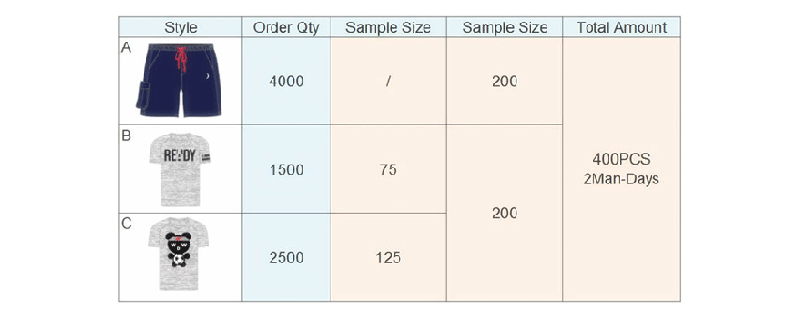
Let’s say you’re inspecting an order of 4,000 units of a single product reference. At General Level II, that puts you at sample size code letter L – a sample of 200 pieces. Using the standard 0/2.5/4.0 defect levels, the reject thresholds for a 125-piece sample are: more than 0 critical, more than 10 major, or more than 14 minor defects.

Scenario A – Accept:
The inspector checks all 200 pieces and finds 0 critical, 9 major, and 13 minor defects. All three counts are within the reject thresholds (0 / 10 / 14), so the AQL accept/reject decision is: accept.
Scenario B – Reject:
Same sample size, same AQL levels. This time the inspector finds 0 critical, 11 major, and 13 minor defects. The major defect count (11) exceeds the reject threshold (10), so the AQL accept/reject decision is: reject – even though critical and minor defects are both within limits. A single category failing is enough to fail the whole inspection.
This is the core logic behind every AQL accept/reject decision: each category is checked independently, and the strictest one that gets exceeded decides the outcome.

Worked Example 2: Why the AQL Level You Choose Changes the Outcome
The same defect count can pass under one AQL level and fail under another. Take the same 200-piece sample in same order quantity 4000pcs, this time with 9 major defects found.
- Under AQL 4.0 for major defects, the reject threshold at this sample size is 14 – 9 defects is well within limits, so the shipment is accepted.
- Under a stricter AQL 1.5 for major defects, the reject threshold drops to roughly 7 – the same 9 defects now exceeds the limit, so the shipment is rejected.

This is why the AQL level agreed with your supplier before production matters as much as the inspection itself: it’s the threshold your accept/reject decision will actually be measured against, and it’s usually written into the purchase contract or the inspection SOP rather than decided on the day of inspection.
What Happens After a Reject Decision?
A reject isn’t necessarily the end of the order – it’s a decision point. Importers typically choose one of the following:
- 100% inspection and sorting – the factory or a third party sorts the full lot, removing defective pieces, and only the conforming units ship.
- Rework and re-inspection – the supplier fixes the identified defects (common for cosmetic or minor issues) and a follow-up inspection is scheduled against the same AQL levels.
- Partial acceptance with a price adjustment – for minor, non-critical issues, some buyers negotiate a discount instead of a full rework, especially when timelines are tight.
- Order cancellation or shipment hold – reserved for critical defects, safety issues, or repeated failures where confidence in the supplier’s process is low.
Which option makes sense depends on the type of defect (critical defects are rarely worth negotiating around), the cost and time impact of rework, and how the relationship with the supplier has gone historically.
Common Mistakes When Making an AQL Accept/Reject Decision
- Averaging defects across categories. A shipment with 0 critical, 12 major, and 2 minor defects is not “fine on average” – the major count alone fails the inspection, regardless of how clean the other categories look.
- Treating “close to the limit” as a pass. A defect count one below the reject threshold is a pass by definition, but it’s also a signal – repeated near-threshold results across shipments usually mean the supplier’s process is drifting, even if each individual shipment technically clears.
- Using the wrong sample size letter. Sample size is driven by lot size and inspection level, not by how many pieces the supplier wants to make available for inspection. Inspecting too few pieces understates real defect rates.
- Ignoring switching rules after consecutive rejects. Under ISO 2859-1, repeated failures are meant to trigger a stricter inspection regime going forward, not just a one-off reject-and-move-on (see below).
Normal, Tightened, and Reduced Inspection: How History Affects Future Decisions
ISO 2859-1 doesn’t treat every inspection in isolation. It defines switching rules based on recent inspection history, moving a supplier between normal, tightened, and reduced inspection depending on whether recent lots have passed or failed. A supplier who has failed the last few shipments should reasonably expect the next inspection to be stricter, not identical. (For the full switching rules and what triggers each level, see our ISO 2859-1 Practical Guide.)
- Normal inspection is the default starting point for a new supplier or product line.
- Tightened inspection kicks in after a defined number of recent lots have been rejected, using stricter AQL levels or smaller acceptance numbers, until the supplier demonstrates consistent quality again.
- Reduced inspection allows smaller sample sizes once a supplier has a strong track record of consecutive accepts, reducing inspection cost without giving up the underlying AQL logic.
In practice, most importers working with a new supplier stay on normal inspection, but it’s worth knowing the rules exist – a supplier who has failed the last few shipments should reasonably expect the next inspection to be stricter, not identical.
When You Need an AQL Accept/Reject Decision
There are times when AQL sampling inspection saves more time and cost compared to other quality control methods. Here are the situations where you should use AQL Inspection:
Large Lot Sizes
For all importers, it is unrealistic to carry out a 100% inspection on every product. It is where AQL Inspection comes into place to inspect products with larger lot sizes. Although not guaranteed, most of your products will be up to requirements.
Automated Manufacturing Process
AQL inspection is more effective, accurate, and consistent using machines. Most products share the same quality, as it’s easier to identify rejected orders. Besides, it reduces the risk of human error as it requires less manual labor.
Once you know when an AQL accept/reject decision applies to your order, the examples above show exactly how to turn your inspection findings into a pass/fail call – and what to do next if the answer is “fail.”
FAQ
-
Can a shipment pass with 0 critical defects but a lot of minor ones?
Only if the minor defect count is within its own threshold. Minor defects have the most lenient AQL (typically 4.0), so they tolerate more instances than major or critical defects – but they still have a limit, and exceeding it fails the shipment regardless of the critical and major counts.
-
Who decides the AQL levels used for the accept/reject call – the buyer or the supplier?
The buyer sets the AQL levels, ideally agreed with the supplier before production and written into the purchase order or inspection SOP, so there’s no dispute about the threshold when the inspection report comes back.
-
Can you negotiate after a reject decision?
Yes, for non-critical defects – partial acceptance with a price adjustment or rework is common. Critical defects are typically not negotiable, since they usually relate to safety or core function.
Final Thoughts
Whether you’re new to quality inspection or refining your QC process, understanding how to reach an AQL accept/reject decision – not just how to read the table – is what turns a sampling plan into an actual go/no-go call on your shipment, and a clear next step when that call is “reject.”
Author: AQI Service is a professional quality control service company in China specialized in providing a complete range of quality inspection and testing certification services in China & Asia for global importers, buyers, retailers, and sellers.