General Inspection Levels Explained: How to Choose Between GI, GII, and GIII
When you open an AQL table for the first time, the top-right section – labeled “General Inspection Levels” – is often the part that gets the least attention. Most buyers pick Level II because that’s what they’ve been told is standard, and move on. That’s usually fine. But understanding what these general inspection levels actually control, and when it makes sense to deviate from the default, is worth the time investment if you’re running any kind of serious import QC program.
This article explains what general inspection levels are, how they affect your sample size and inspection cost, and how to make an informed decision about which one to use based on your product, supplier history, and risk tolerance.
General inspection levels are part of the ANSI/ASQ Z1.4 (ISO 2859-1) acceptance sampling standard – the framework used by quality control professionals worldwide to determine how many units to inspect from a given production lot.
What Are General Inspection Levels?
The standard defines three general inspection levels: GI, GII, and GIII (also written as Level I, Level II, and Level III). Each level maps a given lot size to a different sample size. The higher the level, the larger the sample – and the more statistical confidence you get in the inspection result.
These levels apply to the main body of inspection work: visual and workmanship checks, functional tests, and on-site performance testing. They govern how many units the inspector pulls from across the production lot and evaluates against your specifications.
One important point that often gets overlooked: general inspection levels control sample size, not the pass/fail threshold. That’s set separately by your AQL values – typically 0 for critical defects, 2.5 for major, and 4.0 for minor ( 3 Defects Classification). The two work together: the level determines how many units you check; the AQL determines how many defects in that sample are acceptable before the batch fails. If you’re still working out how to set those AQL values for your products, that’s a separate decision covered in our guide to AQL inspection levels.
GI, GII, GIII – What Each Level Actually Means
Level II (GII) – The Default Starting Point
GII is the standard choice for most consumer goods inspections, and for good reason: it provides a reasonable balance between sample confidence and inspection cost. When no level is specified, ANSI/ASQ Z1.4 defaults to Level II.
Here’s how GII sample sizes work across common lot sizes:
| Lot Size | GI Sample | GII Sample | GIII Sample |
|---|---|---|---|
| 91–150 units | 13 | 20 | 32 |
| 151–280 units | 20 | 32 | 50 |
| 281–500 units | 32 | 50 | 80 |
| 501–1,200 units | 50 | 80 | 125 |
| 1,201–3,200 units | 80 | 125 | 200 |
| 3,201–10,000 units | 125 | 200 | 315 |
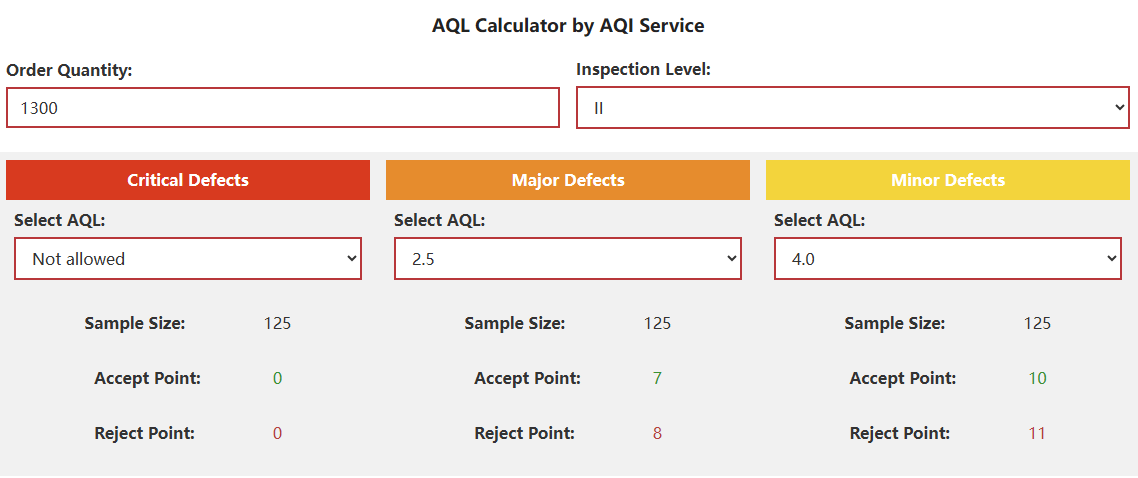
For an order of 1,300 units, GII means your inspector checks 125 units. That sample is large enough to detect quality issues with reasonable statistical confidence, and it keeps inspection time – and cost – at a manageable level.
Use GII as your baseline for:
- First orders with a new supplier (combined with a factory audit if it’s a significant volume)
- Repeat orders from suppliers with a clean inspection history
- Standard consumer goods with no unusual safety or compliance sensitivity
Level I (GI) – Reduced Inspection
GI uses a smaller sample than GII – roughly 60% of the GII sample size for the same lot. For that same 1,300-unit order, GI means checking 80 units instead of 125.
The tradeoff is straightforward: fewer samples checked means lower inspection cost and time, but also lower statistical confidence in the result. You’re more likely to miss a quality problem that’s present in the batch at a low rate.
GI makes sense when:
- You have a long, consistent track record with this supplier – multiple passed inspections with no significant issues
- The product is a repeat order with no specification changes
- The risk profile of the product is low (non-safety-critical items, products where minor defects don’t significantly impact end-user experience)
- You’re making a deliberate, informed decision to reduce inspection intensity, not just defaulting to cheaper
What GI is not: a cost-saving shortcut for first orders or unfamiliar suppliers. Fewer samples inspected means a defective batch is more likely to slip through undetected. The savings on inspection cost can be quickly erased by a shipment rejection or retailer chargeback.
Level III (GIII) – Tightened Inspection
GIII uses roughly 60% more samples than GII. For that 1,300-unit order, GIII means checking 200 units instead of 125. Inspection takes longer, which increases cost – but you get substantially better detection capability for low-frequency defects.
GIII is appropriate when:
- A supplier has recently had quality failures – a failed inspection, a customer complaint, a recall
- You’re launching a new product with an unproven production process
- The product carries higher safety or liability risk (children’s products, electrical items, structural components)
- Lot sizes are small enough that the cost difference between GII and GIII is minimal, making the extra confidence worth it
- You have contractual or regulatory obligations that require a higher inspection intensity
One practical note: for very small orders – say, under 150 units – the difference in sample size between GI, GII, and GIII is modest in absolute terms. In those cases, the level choice matters less than getting the AQL classification right.

General Inspection Levels vs. Special Inspection Levels
The AQL table includes two distinct sections: general inspection levels (GI, GII, GIII) and special inspection levels (S1, S2, S3, S4). They serve different purposes and are often used together in the same inspection.
General Inspection Levels
General levels cover the bulk of inspection activity – the workmanship checks, visual assessment, and functional tests that apply to all units in the sample. This is where most of the inspection time goes.
Special Inspection Levels
Special levels are used for specific tests that are more time-consuming, destructive, or expensive to perform – and therefore done on a smaller sub-sample. Examples include:
- Destructive testing (cutting open a product to check internal construction)
- Electrical safety tests that require setup time
- Chemical sampling for lab analysis
- Dimensional checks that require calibrated equipment and take time per unit
For a typical pre-shipment inspection, an inspector might use GII for the main visual and workmanship check across 125 units, but apply S2 or S3 for a specific performance test – perhaps checking drop resistance on 20 units instead of 125. This approach balances thoroughness with practicality.
When you commission an inspection, your inspection checklist should specify both the general level for the main sample and the special level (if any) for tests that require a reduced sub-sample. Leaving this unspecified means the inspector makes the call – which may not align with your actual risk priorities.
How General Inspection Level Affects Your Inspection Cost
Inspection pricing is typically quoted per man-day. A man-day covers a fixed amount of inspection work – and sample size directly determines how many man-days are needed.
Moving from GII to GIII on a large order can add a half or full man-day to the inspection. For most importers, that’s a modest cost relative to the value of the shipment. But it’s worth understanding the relationship so you can make a deliberate choice rather than defaulting without thinking.
A rough cost impact illustration:
| Lot Size | GII Sample | GIII Sample | Approx. Additional Time |
|---|---|---|---|
| 500 units | 50 units | 80 units | +30–60 minutes |
| 1,200 units | 80 units | 125 units | +1–2 hours |
| 3,200 units | 125 units | 200 units | +2–3 hours |
| 10,000 units | 200 units | 315 units | +half day |
For most B2B buyers, the decision to use GIII on a high-risk order – a new supplier, a safety-sensitive product, a supplier with recent quality issues – is straightforward. The incremental inspection cost is small relative to the cost of accepting a non-conforming shipment.
A Practical Framework for Choosing Your Inspection Level
Rather than always defaulting to GII, consider building a simple decision framework into your QC process:
Start with GII
Level II for any new supplier relationship or new product. This is the baseline that gives you meaningful data without excessive cost.
Step down to GI
Level I only after you have a track record – typically three or more consecutive passed inspections with no major issues, consistent material and specification compliance, and no significant changes to the product or production process.
Step up to GIII
Level III when any of the following apply:
- The supplier failed a recent inspection or had quality complaints from end customers
- The product is safety-critical or subject to mandatory third-party compliance (children’s products, electrical goods, food contact materials)
- You’ve detected a pattern of borderline results at GII – passing inspections but with defect counts close to the AQL limit
- It’s a high-value order where the cost of a non-conforming shipment is significant
Consider 100% inspection
Full Inspection or Piece by Piece Inspection (outside the AQL framework entirely) when:
- Lot sizes are very small and 100% check is feasible within a reasonable timeframe
- A previous shipment contained critical defects requiring full sorting
- The product has zero tolerance for any defect (medical devices, precision components)
Common Mistakes When Applying General Inspection Levels
Using GI by default to reduce cost.
This is the most common mistake. GI should be a deliberate choice based on established supplier performance – not a way to cut inspection spend on a new relationship. A failed batch that passes a GI inspection can cost far more than the inspection savings.
Applying the same level to every product regardless of risk.
A stationery set and a children’s car seat have very different risk profiles. Applying GII to both treats them as equivalent when they’re not. Map your products to inspection levels based on safety sensitivity and the cost consequences of a quality failure.
Not specifying special levels for destructive or time-intensive tests.
If your inspection checklist includes tests that can only be run on a sub-sample, leaving the special level unspecified leads to inconsistent results across inspections. Specify both the general and special levels in every checklist.
Switching levels without documenting the rationale.
If you move a supplier from GII to GI, record why. If a quality issue forces you to GIII, document the trigger. This history is useful when reviewing supplier performance over time – and when a dispute arises.
Putting It All Together
General inspection levels are a small but important decision point in any QC program. The level you choose directly affects how many units get checked, how much statistical confidence you have in the result, and what the inspection costs. GII is the right default for most situations – but using it thoughtlessly across all products and suppliers misses the point of having three levels to choose from.
The underlying principle is proportionality: higher inspection intensity where the risk is higher, reduced intensity where track record and product profile justify it. Building that logic into your QC process – rather than just inheriting whatever level was used last time – is one of those small operational improvements that pays consistent dividends.
If you’re unsure which general inspection level is appropriate for a specific order or product type, AQI Service’s team works through these decisions with importers regularly. The right setup at the start of an inspection program prevents a lot of avoidable problems downstream.
*AQI Service provides pre-shipment inspection, factory audit, and quality control services for importers sourcing from China and across Asia. All inspections are conducted under ANSI/ASQ Z1.4 protocols, with inspection levels and AQL values set in coordination with the buyer based on product type, supplier history, and destination market requirements.

 AQI Service